
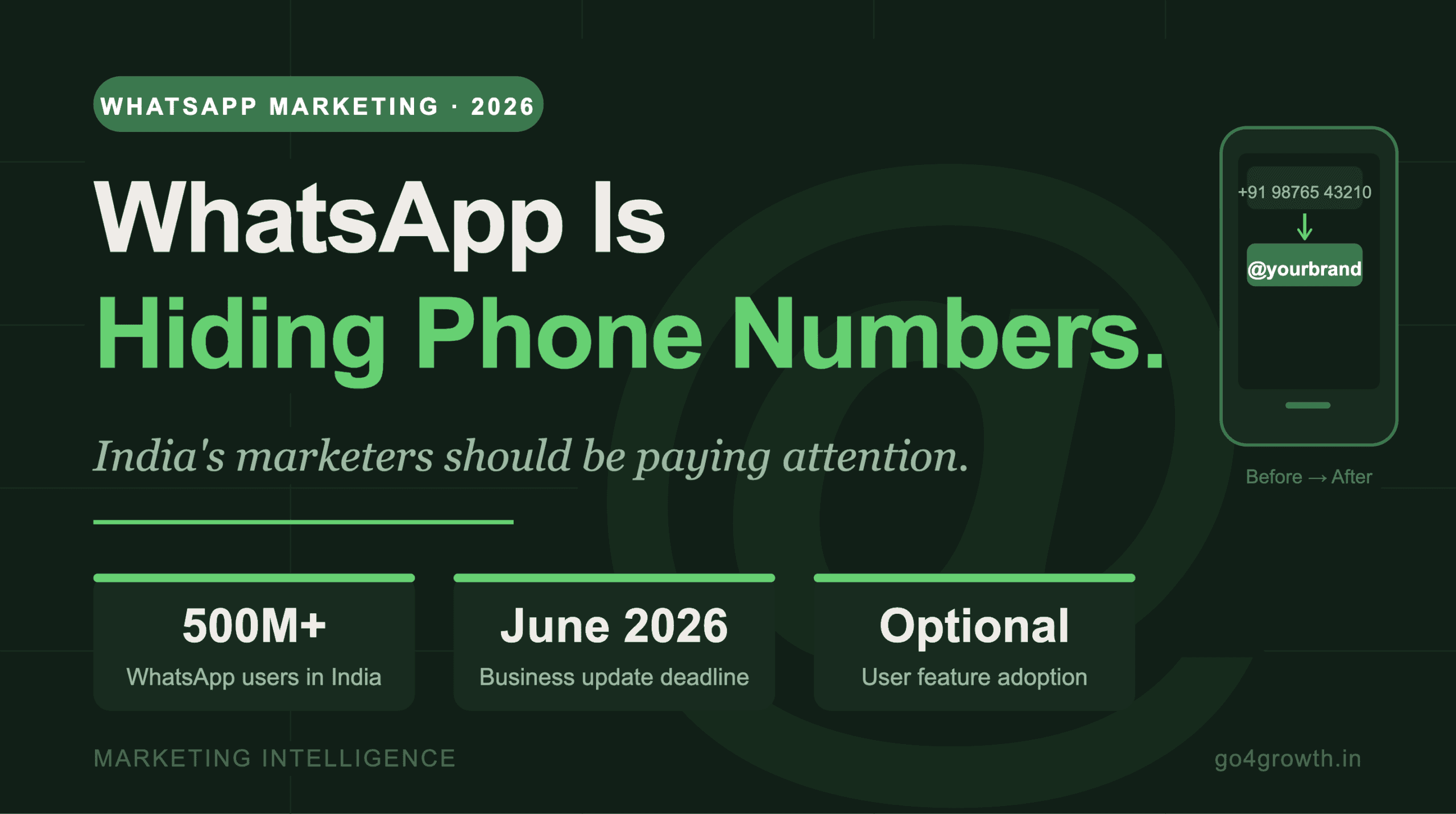
By June 2026, WhatsApp will let users go username-only — no phone number required. For a country where an entire marketing economy runs on mobile numbers, this isn’t just a feature update. It’s a signal.
India has 500+ million WhatsApp users. For businesses of every size — from kirana stores sending offers on family groups to enterprise brands running multi-crore API campaigns — the phone number has been the fundamental unit of commerce on WhatsApp. You got the number, you had the customer.
That logic is about to become more complicated.
WhatsApp has confirmed that usernames — unique handles like @yourbrand — are launching in 2026, with the technical deadline for business systems set at June 2026. The feature introduces a new identity layer to the platform: users will be able to chat, call, and connect without ever revealing their phone number. Behind the scenes, a new identifier called the Business-Scoped User ID (BSUID) will replace phone numbers as the primary link between a customer and a business.
| 500M+ WhatsApp users in India | June 2026 Business systems update deadline | Optional Feature adoption for end users |
First, Let’s Be Clear on What’s Actually Changing
This is not a forced migration. Usernames are an opt-in feature — users who don’t adopt one continue to operate exactly as before. Critically, businesses that already hold customer phone numbers from existing conversations retain them. The existing contact database doesn’t vanish on day one.
But that’s the short-term read. The medium-term picture is more disruptive.
KEY INSIGHT
Phone numbers were never just contact details on WhatsApp — they were the entire acquisition funnel. Collect a number, broadcast a message, close a sale. The username era doesn’t kill that model immediately. It makes it harder to replicate with new customers going forward.
The India WhatsApp Marketing Playbook — And Where It Breaks
Indian WhatsApp marketing has evolved into a sophisticated, if occasionally messy, ecosystem. At the formal end: enterprise brands running verified Business API campaigns, chatbots handling customer support at scale, BFSI companies running OTP-linked authentication flows. At the informal end: purchased number lists, unofficial broadcast tools, and aggressive outreach that rides on the intimacy of a personal messaging app.
The username update creates asymmetric consequences across this spectrum.
| MARKETING SEGMENT | IMPACT | TYPE |
| Official API businesses CRM-integrated, verified accounts | Must update systems by June 2026. Workflow adjustment, not a crisis. | Manageable |
| Bulk / grey-route operators Number lists, unofficial tools | Username-adopting users become unreachable via number-scraping methods. | High Risk |
| Real estate, ed-tech, BFSI Cold outreach in heavy sectors | Cold WhatsApp acquisition shrinks as privacy adoption grows. | Disruption |
| D2C and e-commerce brands Consent-based campaigns | Username handles improve brand recall. Verified @handle builds customer trust. | Opportunity |
| Local & SME businesses WhatsApp Business app users | Branded username replaces forgettable mobile numbers in customer chats. | Positive |
The Structural Shift No One Is Talking About
The deeper implication isn’t technical — it’s behavioural. WhatsApp has explicitly stated that users are more likely to initiate contact with businesses when they can protect their own phone number. This flips the fundamental dynamic of Indian WhatsApp marketing.
“The model shifts from outbound — push your message into someone’s inbox — to inbound — make your brand compelling enough that they come to you.”
That’s a profound change for a market that has historically over-indexed on volume and reach over quality of engagement. It mirrors what happened with email marketing when GDPR arrived in Europe, or what happened to SMS marketing in India after TRAI’s TCCCPR regulations tightened. The channel doesn’t die — it matures.
The Upside India Is Underestimating
Here’s the contrarian take: for serious marketers, this is good news.
A verified @yourbrand username on WhatsApp is a brand asset. It’s memorable, searchable, and portable across communication contexts. It eliminates one of the most persistent problems in Indian WhatsApp marketing — impersonation. A verified username handle, much like Instagram’s blue tick, signals legitimacy instantly.
Moreover, the inbound model — where customers initiate contact by searching a username — is inherently higher-intent. A user who types @zomato into WhatsApp to raise a complaint is more valuable as a data point than a passive recipient of a broadcast message.
What Smart Businesses Should Do Right Now
Six immediate actions for any business running WhatsApp marketing in India:
- Audit your existing WhatsApp workflows for phone-number dependencies — CRMs, chatbots, analytics dashboards, and webhook configurations.
- Begin planning your username handle. Consistency with your Instagram, Twitter/X, and website identity is the smart move.
- If you’re running any grey-route or unofficial broadcast operations, plan the migration to the official WhatsApp Business API. This window won’t stay open.
- Reframe your acquisition strategy around consent-led collection — opt-in forms, click-to-WhatsApp ads, QR code campaigns — rather than purchased number databases.
- Train your customer-facing teams on the new BSUID-based contact flow, including the native ‘Request contact info’ feature WhatsApp is building for businesses.
- For authentication-heavy businesses (banks, fintech, OTP-dependent services): WhatsApp has confirmed authentication messages will continue to operate via phone numbers only. No disruption there.
The Bigger Picture
WhatsApp’s username rollout is part of a larger privacy-first transformation across Meta’s messaging infrastructure. Signal started it. Telegram normalised it. Now the world’s largest messaging platform — with unmatched penetration in India — is moving in the same direction.
For Indian marketers, the message is clear: the era of phone-number-as-proxy-for-consumer is quietly ending. The businesses that will win on WhatsApp in the next five years are those building genuine brand presence, earning customer trust, and creating reasons for people to want to start conversations — not just receive them.
The number used to be the relationship. The username era asks something harder: be worth finding.
Author – Gagan Kapoor, Marketing Consultant and Corporate Trainer
Gagan Kapoor is a Marketing Consultant, Corporate Trainer, Keynote Speaker, and serial entrepreneur with 26+ years of experience in marketing and 13+ years in trainings. Passionate about helping businesses grow and building capability, he specializes in crafting impactful marketing and sales strategies that help brands differentiate, scale, and stay relevant in competitive markets.