Marketing insights, strategic thinking, company news, and field observations from Go4Growth’s consulting practice.
FROM THE BLOG
Marketing
B2B Marketing Strategy for Manufacturers: Turning Marketing Activities Into Demand
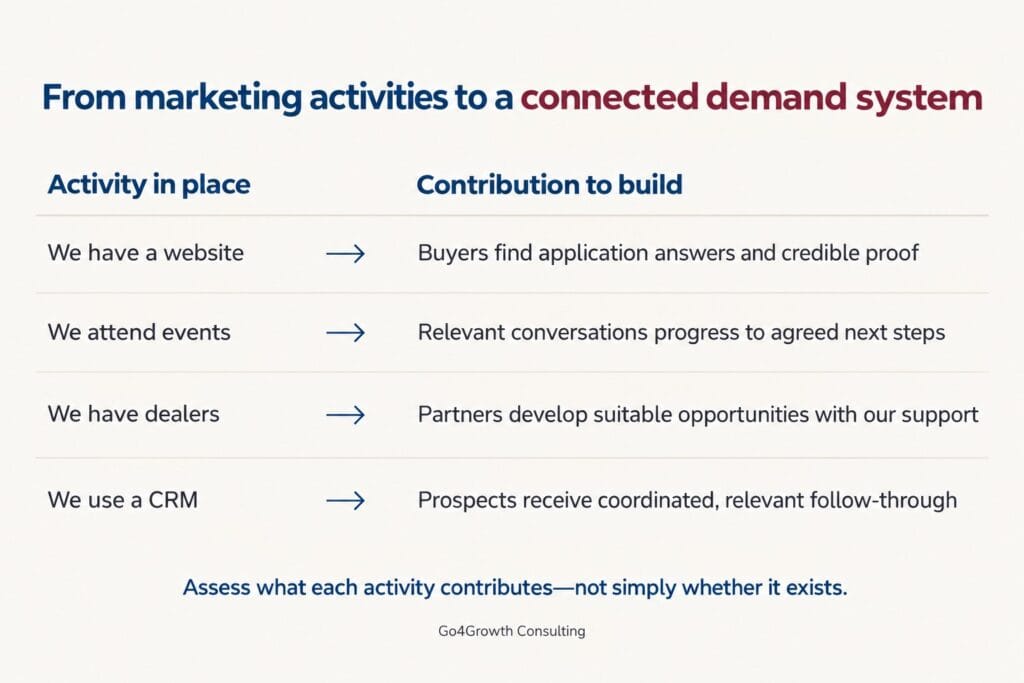
Ask a B2B manufacturer what the company does for marketing, and the answer may sound familiar: “We have a website. We participate in a few exhibitions. We have dealers in key markets. We have also invested in a CRM.”
These are useful investments. Yet a few questions can reveal a gap. Does the website help buyers understand where the company can add value? Are dealers equipped to develop demand? Do exhibition conversations continue after the event? Does the CRM help progress opportunities—or simply store contacts?
A business can have all these elements and still struggle to explain where its next customers will come from. Activities have their own budgets and owners, but little connection. Prospects repeat their requirements to different teams, promising enquiries lose momentum, and new-market entry still depends on someone opening a door.
The management question is whether these activities work together to help the business reach and win the customers it wants.
An effective B2B marketing strategy for manufacturers starts with the customers and applications the business wants to serve, and a credible reason for those buyers to choose it. The next task is to organise marketing around that direction. The Four-Part B2B Demand Framework makes that task practical.
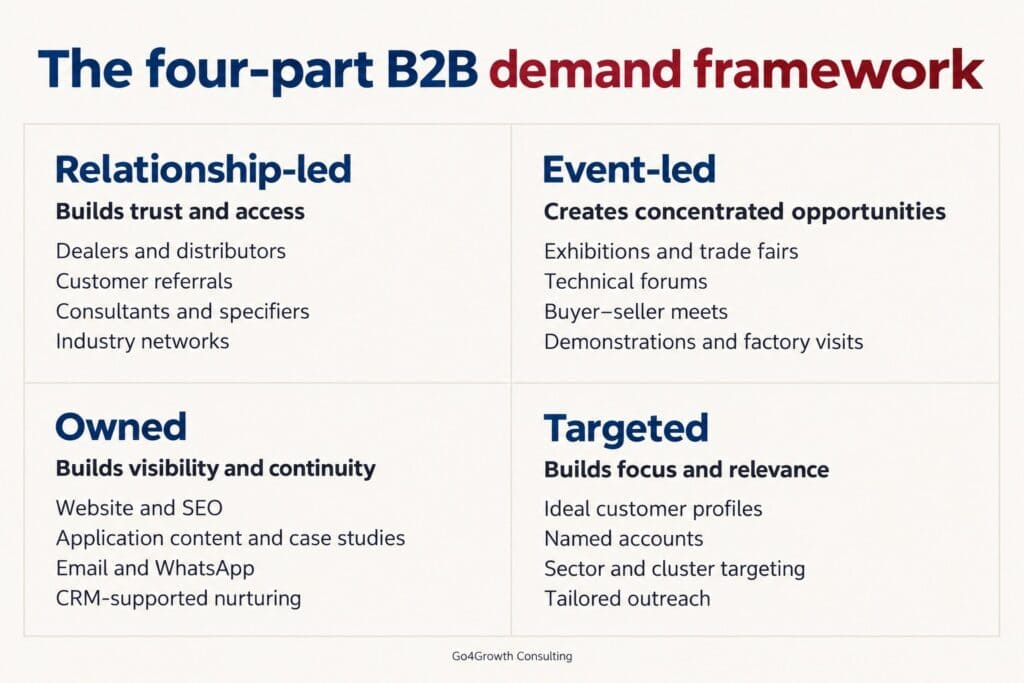
The Four-Part B2B Demand Framework
Each part has a distinct role in helping suitable buyers discover, evaluate and engage with your business. This includes developing future interest and responding to requirements that already exist.
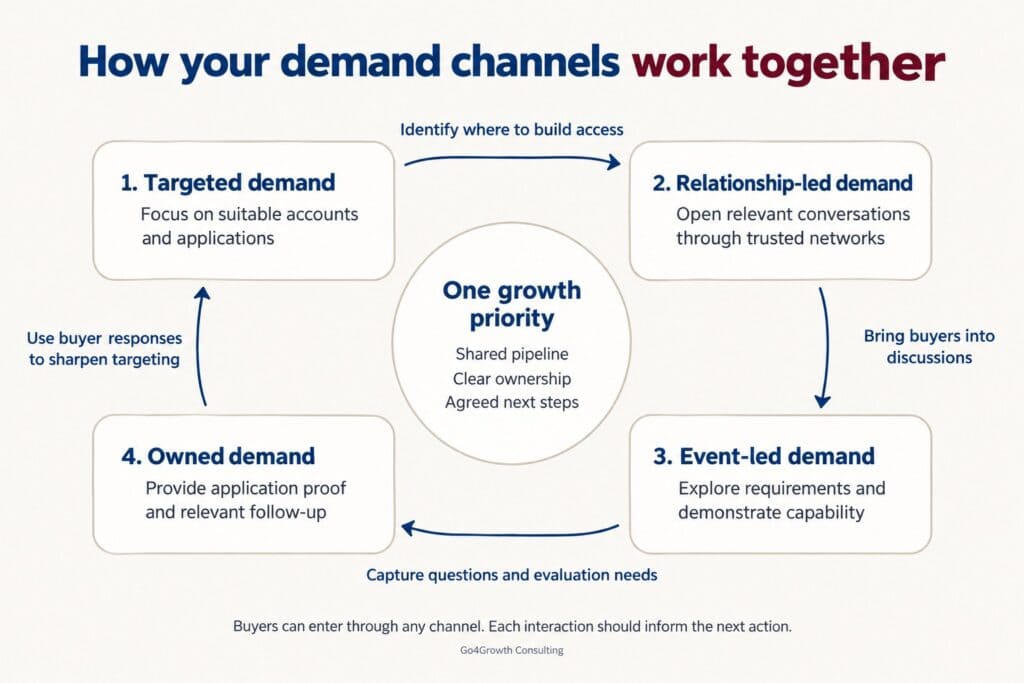
These are connected capabilities. A case study can support a dealer, an event conversation and a target account. A CRM supports follow-through across all four. The framework helps assign a purpose to each activity and connect it to the buyer’s next decision.
1. Relationship-led demand builds trust and access
Relationships give buyers greater confidence in considering a supplier. Dealers provide local reach, customers introduce new opportunities, and professional influencers can shape selection without placing the order. The manufacturer needs to give this network useful reasons to recommend its products.
Core channels and activities
Dealers and distributors. Provide local access, customer relationships and support for product availability.
Existing customers and referrals. Open conversations with other plants, teams and businesses through demonstrated experience.
Consultants and specification influencers. Help shape the products and suppliers buyers consider.
Referral partners and professional networks. Create introductions through relevant associations, affiliates and industry relationships.
The manufacturer’s role
Equip the channel to create demand. Give dealers application guides, product comparisons and credible project evidence for customer conversations.
Support those who influence selection. Build relevant engagement with architects, consultants, contractors or technical specialists.
Develop customer introductions. Use successful projects to explore other sites, applications and suitable referrals.
Industry example — Building materials. A waterproofing manufacturer could support dealers with application guides and hold technical sessions for architects and contractors. These help explain suitable uses and installation requirements. The dealer supports local supply while the wider network builds confidence in selection.
Watch-out. Dependence on a few people or partners can restrict access to new markets.
Exhibitions, trade fairs and technical forums bring relevant buyers together. Demonstrations make capability tangible, while factory visits help prospects assess production capability and the people behind it. These formats create concentrated opportunities for discovery and evaluation.
Core channels and activities
Exhibitions and trade fairs. Bring suitable buyers into contact with products, demonstrations and technical teams.
Conferences and technical forums. Create focused discussions around industry needs and application challenges.
Buyer–seller meets. Enable introductions and requirement discussions with potential customers.
Demonstrations and factory visits. Help prospects assess performance, production capability and service support.
The manufacturer’s role
Choose events around market priorities. Select settings that attract buyers from the sectors and applications you want to develop.
Demonstrate relevant capability. Show how your equipment or expertise addresses a recognisable buyer problem.
Connect interest to a next step. Agree a technical discussion, evaluation or commercial conversation, with a named owner.
Industry example — Industrial machinery. A machinery manufacturer could demonstrate equipment at a trade fair, discuss a production bottleneck with plant managers at a technical forum, and invite a suitable prospect to its factory. Each interaction provides evidence that helps the buyer decide whether to proceed.
Watch-out. Event activity is intermittent; demand development must continue between exhibitions.
3. Owned demand builds visibility and continuity
Owned demand keeps your expertise accessible between meetings. Your website, content and direct communications help buyers evaluate the business and stay engaged as requirements develop. The company manages these assets, although search and messaging platforms still influence their reach.
Core channels and activities
Website, application pages and SEO. Help buyers discover the business and understand its relevance to their needs.
Technical content and case studies. Explain selection considerations and provide evidence of capability.
Email and relevant WhatsApp communication. Maintain useful, permission-based contact as buyer needs develop.
Databases and CRM-led nurturing. Organise prospect information and support timely, relevant follow-up.
The manufacturer’s role
Answer real application questions. Build website content around buyer needs, selection considerations and technical questions, supporting useful search discovery.
Substantiate your capability. Publish relevant specifications, documented case studies and evidence that helps buyers evaluate suitability.
Maintain relevant contact. Organise prospect information by application and buying stage, and connect useful follow-up to a clear response path.
Industry example — Specialty chemicals and polymers. A supplier could publish application notes, grade-selection guidance and documented trial results. A processor can assess relevant operating conditions before requesting an evaluation. Useful email updates maintain familiarity while the project develops.
Watch-out. Generic content and an unattended CRM create little value; relevance and follow-through matter.
4. Targeted demand creates focus and relevance
Targeted demand starts with choosing whom the business wants to serve. An ideal customer profile guides sector, geography and account selection. Account-based marketing and tailored outreach connect suitable organisations with relevant evidence through coordinated sales and marketing programmes.
Core channels and activities
Ideal customer profiles and account lists. Define suitable buyers and identify organisations worth developing.
Sector, geography and cluster targeting. Concentrate effort in markets where the business has a credible fit.
Account-based marketing and tailored outreach. Present relevant capability evidence to selected accounts and stakeholders.
Joint sales–marketing programmes. Coordinate messages, engagement and technical support around shared account priorities.
The manufacturer’s role
Select accounts against a clear profile. Prioritise organisations whose requirements fit your technical capability and commercial goals.
Map the buying group. Identify engineering, quality, procurement and operations stakeholders, and understand the evidence each needs.
Coordinate account development. Align sales, marketing and technical teams around account-specific conversations and evaluation milestones.
Industry example — Auto components. A components manufacturer could target OEMs and Tier-1 suppliers with suitable requirements. Engineering may need process and sample evidence, quality teams may examine systems, and procurement may assess supply capability. The account programme coordinates these needs rather than sending everyone the same introduction.
Watch-out. A target list achieves little without a credible fit, relevant engagement and a meaningful next step.
Connect the four channels around one growth priority
Consider a packaging manufacturer pursuing regional food companies. Its marketing effort becomes more purposeful when all four channels support that same customer priority. The connections can work in several directions; buyers do not need to follow a fixed sequence.
Use relationships to open relevant doors. Ask suitable distributors and existing customers for introductions to food companies whose requirements fit your capabilities.
Use targeted outreach to develop those accounts. Identify packaging-development and procurement stakeholders, understand their application and invite them to a relevant technical discussion.
Use events to make capability tangible. Bring suitable prospects to a demonstration or arrange meetings at a relevant exhibition, supported by the technical team.
Use owned content to support evaluation. Share an application page or credible case study that helps the buyer assess suitability and discuss it internally. Use recurring buyer questions to improve that content.
Manage one shared opportunity pipeline. Give each opportunity an owner and an agreed next step. Record the original source and later contributions without counting the same opportunity several times.
Build a manageable demand mix
Shortlist one or two relevant activities from each channel around your chosen growth priority. Retain what works, identify the missing support and sequence improvements according to your team’s capacity. The mix needs to cover all four roles; spending and effort need not be equal.
For example, a machinery business may put more effort into demonstrations and named accounts, while a building-materials company may prioritise partners and specification support. Strengthen the gap most likely to obstruct your growth objective, while connecting that improvement to the other channels.
Checklist for a connected demand system
Review these questions with sales, marketing and technical colleagues. Mark each row as working, partly working or a gap, using a recent opportunity as evidence. Owning a tool is not enough to mark its role as working.
Use the review to agree which gap matters most for your next growth priority, what will change, who owns the improvement and when you will assess progress. Judge that progress through relevant conversations, technical evaluations and qualified opportunities, alongside eventual orders.
The next step is to make your marketing investments work together. Give each activity a clear role, connect it to the customers you want to serve, and make someone accountable for moving the opportunity forward.
Author – Gagan Kapoor is a marketing strategy advisor and Principal Consultant at Go4Growth Consulting. He works with growing and mid-sized businesses to strengthen their marketing strategy, positioning and organisational marketing capability. His doctoral research explores marketing capability and how organisations can build it to support sustainable business growth.
Why Growing Businesses Need Marketing Capability, Not Just More Marketing
As businesses grow, an interesting thing happens to marketing.
There is usually more of everything. More campaigns, more agencies, more exhibitions, more content, more digital spending, more people and, increasingly, more technology. A growing business that once depended largely on relationships and market understanding may now have a marketing team, a CRM platform, multiple agency partners and a reasonably substantial annual marketing budget.
Yet, despite all this activity, many leadership teams continue to struggle with some surprisingly fundamental questions.
Which customer segments should we prioritise?
Why should customers choose us over increasingly similar competitors?
Which markets represent the best opportunities for growth?
Is our positioning genuinely differentiated?
Are marketing and sales working towards the same customers and outcomes?
Which marketing investments are actually contributing to business growth?
When these questions do not have clear answers, the problem may not be that the organisation needs more marketing.
It may need greater marketing capability.
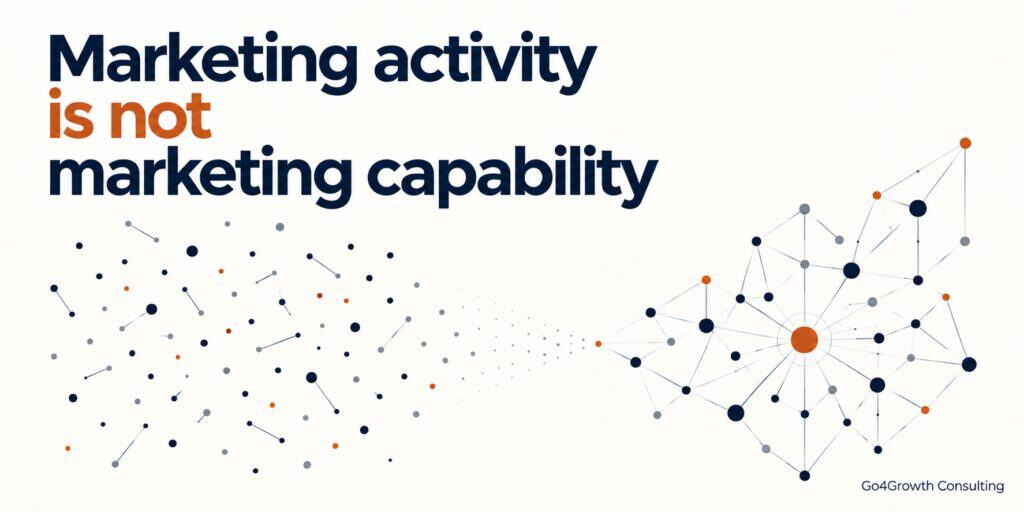
Marketing activity and marketing capability are not the same thing
Consider a hypothetical ₹200-crore manufacturing business.
It participates in six major exhibitions every year, works with a digital agency, regularly produces brochures and product catalogues, runs social media campaigns and has a five-member marketing team. From the outside, it would certainly appear to be marketing actively.
Now ask the leadership team to identify its three most valuable customer segments and explain why each should choose the company over its competitors. Ask how insights from lost sales opportunities influence its marketing decisions. Ask which exhibitions produce the most commercially valuable relationships, or how customer and competitor intelligence affects product, pricing and market-entry decisions.
The answers may suddenly become less certain.
The organisation doesn’t necessarily have a marketing activity problem. It has a marketing capability problem.
Now consider another business that perhaps spends less on marketing but operates very differently. It systematically studies customers and competitors, identifies priority segments, defines clear value propositions for them, captures market intelligence from its sales team, reviews why opportunities are won and lost, and regularly reallocates marketing resources based on what it learns.
The second organisation may actually be doing fewer marketing activities. But it possesses greater marketing capability.
That distinction becomes increasingly important as businesses scale.
So, what exactly is marketing capability?
In practical terms, marketing capability is an organisation’s ability to understand its market, make informed marketing choices and consistently translate those choices into customer and business outcomes.
The important word here is ability.
Having a CRM is a resource. Knowing how to use customer information from that CRM to improve segmentation, sales priorities and retention is a capability.
Hiring a marketing agency gives an organisation access to expertise. Knowing what the agency should accomplish, which customers it should target, what positioning it should communicate and how its performance should be evaluated requires capability within the organisation.
Similarly, attending exhibitions, running Google campaigns, creating content or implementing marketing automation can all be useful activities. But none of them, individually or collectively, establishes that an organisation has developed strong marketing capability.
This is why increasing marketing expenditure does not automatically produce better marketing.
What does marketing capability look like in a growing business?
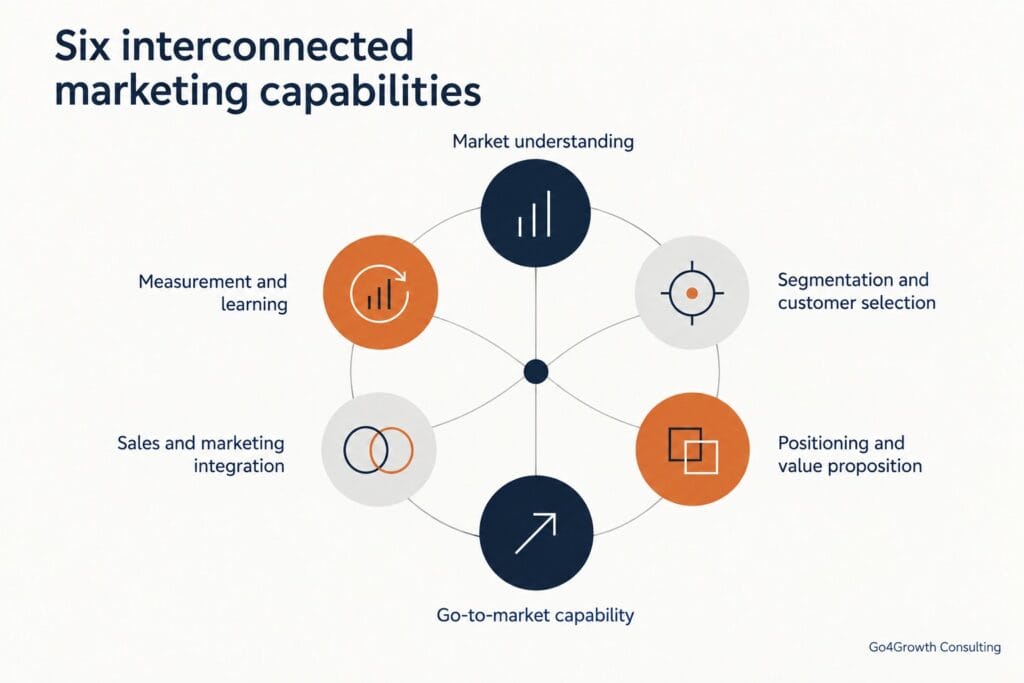
Strong marketing capability does not reside only within a marketing department. It is reflected in a set of interconnected organisational abilities.
It starts with market understanding. Does the organisation systematically understand customers, competitors, changing buying behaviour and emerging opportunities, or does most of this knowledge continue to reside in the minds of a few senior people?
The next capability is segmentation and customer selection. Growing businesses frequently want to sell to everyone who could potentially buy from them. More mature marketing organisations make choices. They know which segments are strategically important, what those customers value and where the organisation should disproportionately invest its resources.
Then comes positioning and value proposition. If competitors are making broadly similar claims about quality, service, experience and reliability, why should the customer choose you? A capable organisation can articulate differentiated value in terms that matter to the customer rather than simply describing its own products.
The fourth is go-to-market capability. The question is no longer whether digital marketing, distributors, exhibitions, direct sales, partnerships, content or account-based marketing is ‘best’. The organisation understands which combination is appropriate for particular markets, customer segments and buying journeys.
Equally important is sales and marketing integration. Marketing capability weakens considerably when marketing generates communication while sales operates independently. Customer conversations, objections, lost opportunities and competitor information from the field should continuously strengthen marketing decisions, while marketing should help sales prioritise markets, accounts and propositions.
Finally, there is measurement and learning. Capable organisations do not simply measure what is easiest to count. They continuously ask what is working, what is changing, what they are learning about the market and where resources should move next.
These capabilities reinforce one another. That is why marketing capability is much larger than the marketing department itself.
You cannot completely outsource marketing capability
This distinction has another important implication.
A business can—and often should—outsource specialist marketing activities. Advertising, digital marketing, content production, design, research, technology implementation and many other areas can benefit enormously from external expertise.
But the organisation cannot outsource its fundamental understanding of its customer and market.
An agency can help execute a campaign, but the organisation must ultimately know which customers matter. A research firm can provide market data, but management must know how that information changes strategic choices. A technology platform can provide sophisticated dashboards, but someone must know which questions are worth asking. External partners can strengthen marketing capability. They cannot substitute for its absence.
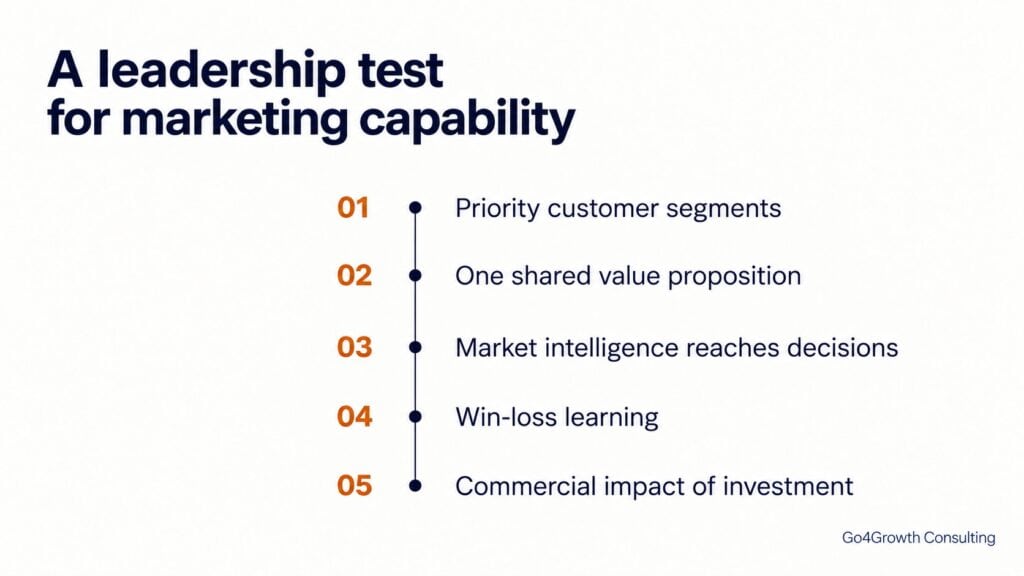
A useful test for leadership teams
Perhaps the simplest way to evaluate marketing capability is not to begin with the marketing budget at all. Instead, leadership teams should ask themselves five harder questions:
1. Can we clearly identify the customer segments that will drive our next phase of growth?
2. Do our sales and marketing teams articulate our value proposition in broadly the same way?
3. Does customer and competitor intelligence systematically reach the people making strategic decisions?
4. Do we understand why we win and lose important business—and use those insights to make better marketing decisions?
5. Can we connect our major marketing investments to meaningful commercial outcomes?
The answers to these questions reveal considerably more about an organisation’s marketing capability than the size of its marketing department, the number of campaigns it runs or the sophistication of its technology stack.
The next marketing investment may not be another marketing activity
For growing businesses, the temptation is understandable. When growth slows or competition intensifies, the instinctive response is often to increase activity: launch another campaign, appoint another agency, enter another channel, attend another exhibition or implement another technology platform.
Sometimes that is exactly what is required.
But before asking “What more should we do in marketing?”, leadership teams may benefit from asking a more fundamental question:
“What marketing capability do we need to build as an organisation?”
Because sustainable growth does not come simply from doing more marketing. It comes from becoming progressively better at understanding markets, making choices, executing those choices and learning from the results.
And as businesses become larger and markets become more competitive, that capability may ultimately matter far more than the number of marketing activities they undertake.
Author – Gagan Kapoor is a marketing strategy advisor and Principal Consultant at Go4Growth Consulting. He works with growing and mid-sized businesses to strengthen their marketing strategy, positioning and organisational marketing capability. His doctoral research explores marketing capability and how organisations can build it to support sustainable business growth.
Why RCS Should Be In Your Marketing Strategy Right Now? And What WhatsApp's New Rules Are Telling You About the Future of Business Messaging
Every few years, a channel shift happens that most businesses are too slow to act on. It happened with email marketing, then with social media, then with WhatsApp. Right now, quietly but quite decisively, it is happening again — with RCS.
If you haven’t heard of RCS yet, or if you’ve only vaguely come across the term, this piece is for you. And if you’re already doing WhatsApp marketing and haven’t had a strategic conversation about what happens next, then this piece is especially for you.
Let’s start with what’s changing — and why it matters more than most businesses currently realise.
First, What Exactly Is RCS?
RCS stands for Rich Communication Services. Think of it as SMS finally growing up. It’s the next-generation messaging standard that delivers the kind of experience you associate with apps like WhatsApp or iMessage — but it lives natively in a phone’s default messaging app, without requiring the user to download anything.
What does that mean in practice? It means a business can send messages that include:
High-resolution images and videos
Interactive carousels for product showcases
Call-to-action buttons and quick replies
Verified sender branding with your logo and company name
Read receipts and delivery confirmations
Location sharing and rich media documents
This is no longer just SMS dressed up in a new outfit. RCS is a fundamentally different communication experience — one that sits closer to a mini app within the messaging inbox.
The critical differentiator: Your message lands in the customer’s default messaging app — not inside a third-party platform. That means zero app downloads, zero platform dependency, and a trusted, native experience.
The iPhone Factor — This Is the Game Changer
For years, RCS was mostly an Android story. Google pushed hard for it. Android adopted it. But with the majority of premium smartphone users on iPhones, the channel had a ceiling.
That ceiling has now been removed.
With Apple’s iOS 18 and subsequent updates, iPhones now support both person-to-person RCS messaging and RCS for Business — what was previously called RCS Business Messaging. In fact, the iOS 18.4 update in March 2025 expanded compatibility to additional US carriers, and Apple has confirmed upcoming support for RCS Universal Profile 3.0, which will bring end-to-end encryption across platforms. What was once a one-sided Android feature is rapidly becoming a universal standard.
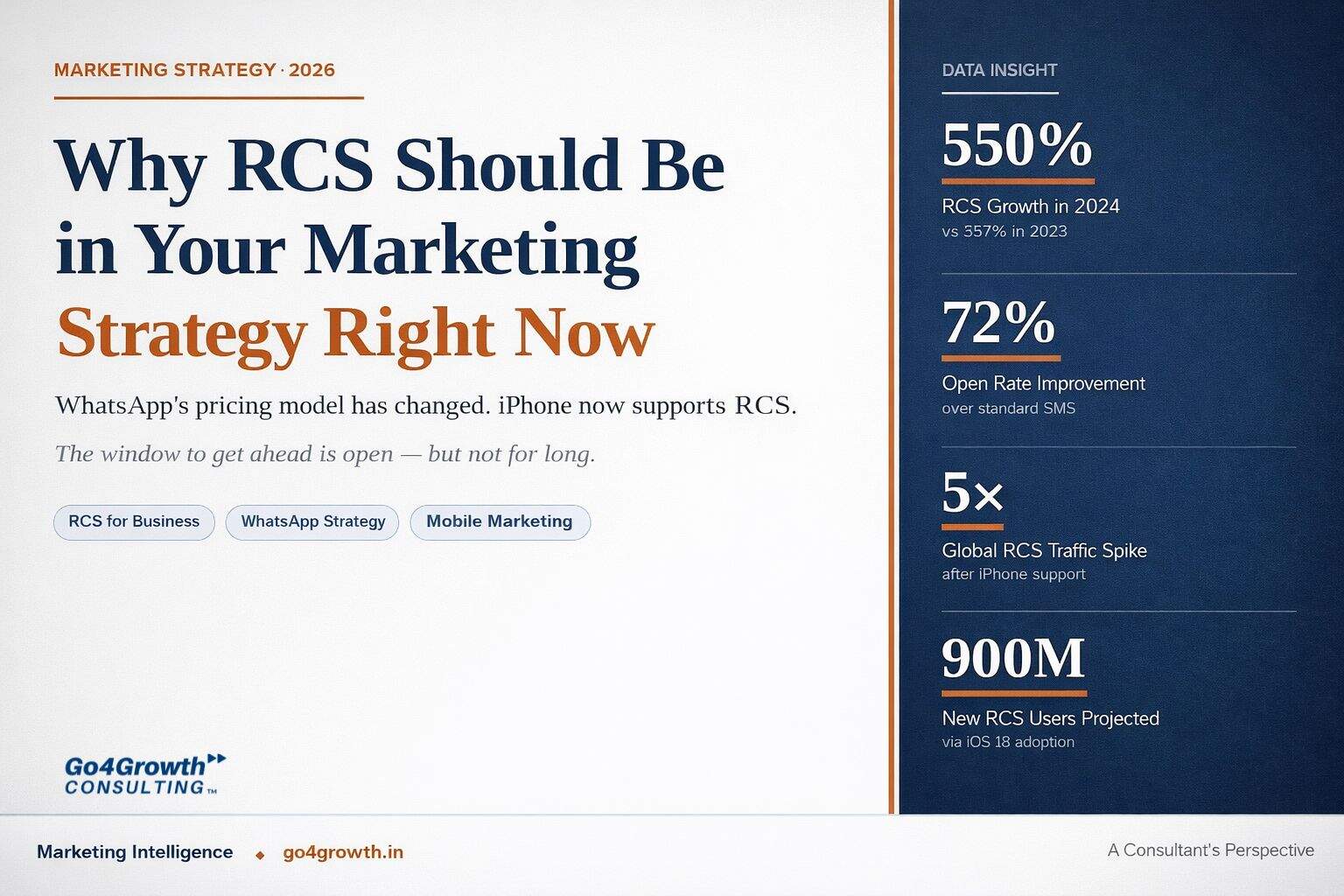
The numbers speak clearly here: global RCS traffic grew approximately 5x in 2024 after Apple joined the ecosystem. In North America alone, the surge was 14x. A billion daily RCS messages are now being exchanged in the United States. Juniper Research projected that Apple’s support would add 900 million new active users to the RCS channel.
For businesses, this isn’t just a technical update. It’s a distribution shift. The audience you can now reach through RCS for Business, on both Android and iPhone, has expanded dramatically.
What RCS Can Actually Do for Your Marketing
Let me be direct here: from a marketing strategy standpoint, RCS sits in a sweet spot that no existing channel currently occupies.
It has the reach of SMS — landing in the native inbox with no install friction. But it has the richness of a messaging app — carousels, images, buttons, replies. And it carries verified brand identity — your logo, your tagline, a checkmark showing the message is genuinely from you.
Verified Brand Identity
In a world drowning in phishing attempts and spoofed messages, a verified sender profile is a significant trust signal. Customers can see your brand name, logo, and a verification checkmark. The credibility that comes from this is hard to build through other channels.
Interactive Commerce Within the Message
One of the most compelling capabilities of RCS is something called WebView — the ability to embed web experiences directly within a message. Imagine a customer browsing a product carousel in their messaging inbox and completing a purchase without ever leaving the message thread. The drop-off that happens when you redirect people to a browser is eliminated. For e-commerce and high-consideration purchases, this is a significant conversion lever.
Better Data, Better Decisions
Unlike SMS, where delivery confirmation is unreliable and engagement is invisible, RCS provides real data: delivery receipts, read timestamps, and post-back data from button interactions. Marketers can now know not just whether a message was delivered, but whether it was read, which button was tapped, and at what time — all of which enables far more intelligent follow-up sequencing.
Open Rate Advantage
Industry data points to open rates improving by as much as 72% when comparing RCS to traditional SMS campaigns. The combination of visual richness, verified identity, and native inbox placement creates a compelling engagement dynamic.
Strategist’s Perspective: RCS doesn’t replace your existing channels — it fills the gap between transactional SMS and conversational WhatsApp. Used correctly, it becomes a high-engagement broadcast-plus-interaction layer that your competitors likely haven’t built yet.
What Is Happening with WhatsApp — And Why It Should Concern You
Many businesses, especially in India and other markets where WhatsApp penetration is high, have built their entire messaging strategy around WhatsApp Business. It’s understandable. The platform has extraordinary reach, near-universal adoption, and strong engagement. But the ground beneath it is shifting.
The Pricing Model Has Changed
From July 2025, Meta moved WhatsApp Business Platform pricing from a conversation-based model to a per-message model. What this means in simple terms: previously, you paid per 24-hour session and could send multiple messages within that window at no additional cost. Now, every template message — whether marketing, utility, or authentication — is billed individually.
Marketing messages, which are the most commonly used for outreach and promotions, are now individually charged at rates that vary by country. For high-volume campaigns, this adds up quickly. The days of blasting a large customer list with multiple follow-up messages inside a conversation window, all for a flat fee, are effectively over.
The Rules Are Getting Stricter
WhatsApp has also tightened the classification of message types. Utility templates — which attract lower charges — now face stricter scrutiny. You can no longer blend a transactional message with any promotional content without risking reclassification into the more expensive marketing category. WhatsApp is actively pushing businesses toward a quality-first, intent-based messaging approach.
Moreover, WhatsApp has imposed per-user marketing limits, meaning if a user is not engaging with your messages, you will be progressively restricted from reaching them. The mass-broadcast model of WhatsApp marketing is being dismantled — deliberately and systematically.
With WhatsApp hiding phone numbers and shifting to username-based identities, the entire foundation of WhatsApp marketing is about to change. Know more in the blog below.
For businesses doing serious volumes on WhatsApp, this translates to a meaningful cost increase unless messaging practices are tightened significantly. Combined with the operational effort of managing template approvals, categorizations, and compliance, WhatsApp marketing is becoming both more expensive and more demanding. That is a strong reason to look at what alternatives or complements exist.
This is not a reason to abandon WhatsApp. It remains a powerful relationship channel, particularly for customer service and high-intent interactions. But it is a reason not to make WhatsApp your only mobile messaging strategy.
RCS and WhatsApp — Not Versus, But Together
Here is where strategy gets interesting.
The instinct is often to frame this as a choice: WhatsApp or RCS? But that’s not the right frame. These channels serve overlapping yet distinct purposes, and a sophisticated marketing strategy will use both — intelligently.
Think of it this way:
WhatsApp is a relationship channel. Its strength lies in two-way conversation, customer service, and high-intimacy communication. The opt-in nature, the personal feel of the interface, and the conversational dynamic make it ideal for nurturing relationships with customers who’ve already engaged with your brand.
RCS is a broadcast-to-engagement channel. It’s closer in function to a sophisticated email or SMS campaign — but with the visual richness and interactivity of an app. It works well for acquisition touchpoints, product announcements, time-sensitive offers, and automated customer journeys.
A smart integration might look like this: You use RCS to run an interactive product campaign reaching your full mobile database. Users who respond or click through are identified as high-intent leads. You then move that segment into a WhatsApp conversation for personalised follow-up, closing the loop on a journey that began with broadcast and ended in dialogue.
This is omnichannel mobile marketing at its most effective — each channel doing what it does best, handing off to the other at the right moment.
What Businesses Should Do Right Now
If you’re serious about building a future-ready marketing infrastructure, here is how I’d frame the priorities:
1. Audit Your Current WhatsApp Dependency
Map out your current WhatsApp Business usage — volume, categories, costs, and engagement rates. Understand where the new per-message pricing hits you hardest and where you can restructure templates or journeys to reduce cost. This isn’t just damage control; it’s an opportunity to clean up messaging practices that were never as strategic as they should have been.
2. Explore Your RCS Readiness
Speak to your messaging platform providers — whether you use a cloud communications vendor or a marketing platform — and ask specifically about their RCS for Business capabilities. Assess carrier coverage in your primary markets. In India, for example, RCS adoption among telecom operators is growing and the addressable audience is substantial. Understand what it takes to get a verified sender profile set up.
3. Start With a Pilot
Don’t wait for RCS to become mainstream before you experiment. Brands that pilot today will have the learning curve behind them by the time mass adoption hits. Consider running a single campaign — a product launch, a seasonal offer, a reactivation series — purely on RCS. Measure engagement against your SMS or WhatsApp benchmarks. The data will tell you the story.
4. Build a Multi-Channel Mobile Strategy
The fundamental shift you need to make is moving from thinking about individual channels to thinking about mobile messaging as a portfolio. Email, SMS, RCS, WhatsApp, and push notifications each have a role. Orchestrating them based on customer behaviour, context, and intent is what separates brands that build lasting mobile relationships from those that just broadcast.
5. Invest in Message Quality, Not Message Volume
Both WhatsApp’s new pricing model and RCS’s engagement dynamics point in the same direction: message quality matters more than message quantity. A well-crafted RCS message with a compelling visual, a clear CTA, and personalisation will outperform ten generic text blasts. The shift in economics of WhatsApp is actually nudging businesses toward better marketing habits — take the hint.
The Bottom Line
RCS is not a future technology. It is a present-tense opportunity. With iPhone now fully in the picture, with carrier coverage expanding rapidly, and with major platforms like Twilio and Infobip making RCS capabilities widely accessible, the infrastructure is there. What’s missing for most businesses is the strategic intent.
WhatsApp will remain important — but its economics and rules are changing in ways that should prompt every business to diversify its mobile messaging mix. RCS is the most logical complement: open standard, no platform gatekeeping, verified branding, and richer engagement than anything SMS has ever offered.
For businesses serious about building marketing systems that work — not just campaigns that run — RCS deserves a seat at the strategy table. The question is not whether to include it. The question is how quickly you can move.
About the Author
Gagan Kapoor is a Marketing Consultant and the Founder of Go4Growth Consulting. He works with businesses across industries on marketing strategy, brand positioning, go-to-market planning, and building marketing systems that drive sustainable growth. He also leads corporate training programs for leadership and strategic thinking at large organisations.
WhatsApp Is Hiding Phone Numbers. India’s Marketers Should Be Paying Attention.
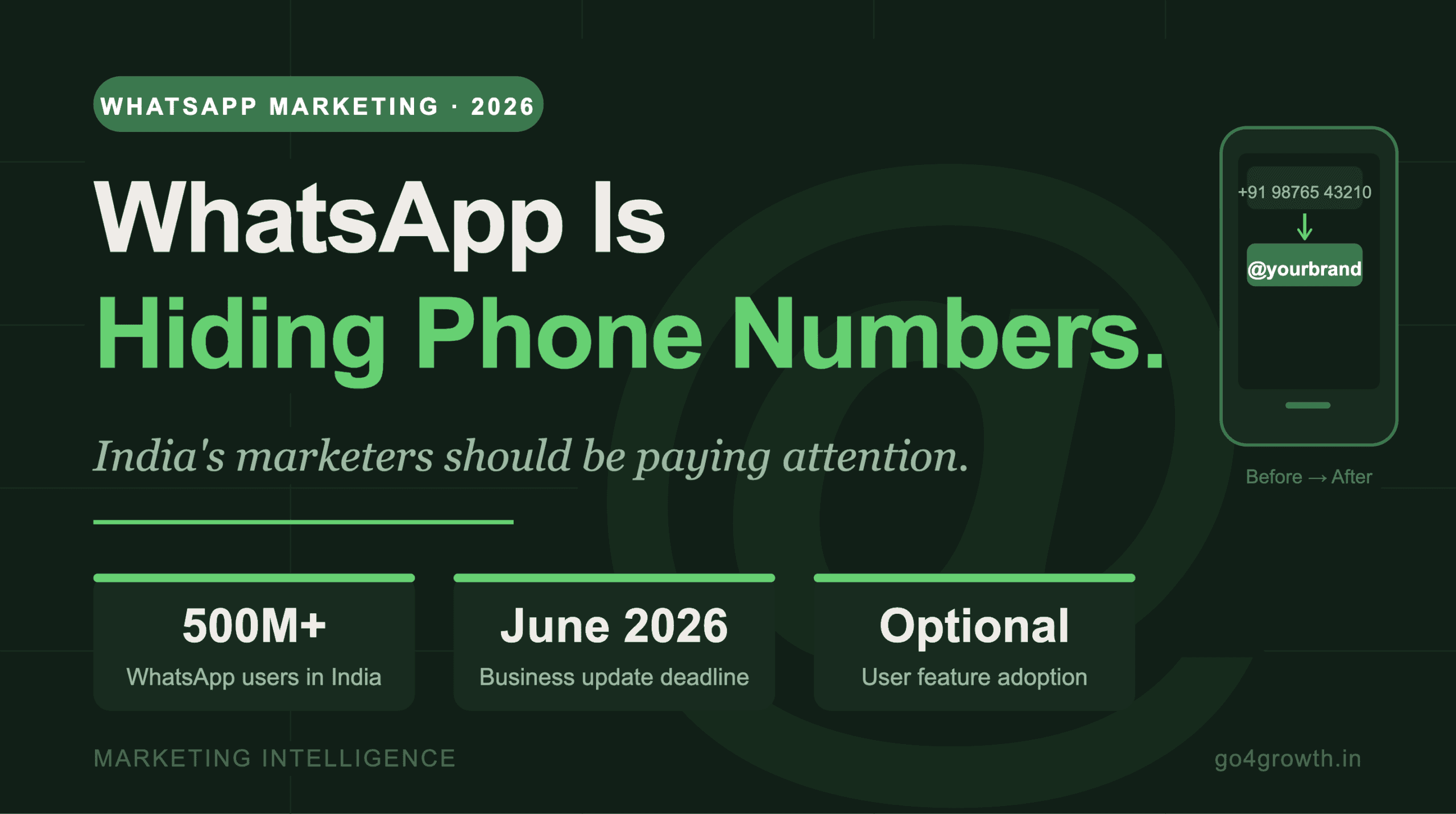
By June 2026, WhatsApp will let users go username-only — no phone number required. For a country where an entire marketing economy runs on mobile numbers, this isn’t just a feature update. It’s a signal.
India has 500+ million WhatsApp users. For businesses of every size — from kirana stores sending offers on family groups to enterprise brands running multi-crore API campaigns — the phone number has been the fundamental unit of commerce on WhatsApp. You got the number, you had the customer.
That logic is about to become more complicated.
WhatsApp has confirmed that usernames — unique handles like @yourbrand — are launching in 2026, with the technical deadline for business systems set at June 2026. The feature introduces a new identity layer to the platform: users will be able to chat, call, and connect without ever revealing their phone number. Behind the scenes, a new identifier called the Business-Scoped User ID (BSUID) will replace phone numbers as the primary link between a customer and a business.
500M+ WhatsApp users in India
June 2026 Business systems update deadline
Optional Feature adoption for end users
First, Let’s Be Clear on What’s Actually Changing
This is not a forced migration. Usernames are an opt-in feature — users who don’t adopt one continue to operate exactly as before. Critically, businesses that already hold customer phone numbers from existing conversations retain them. The existing contact database doesn’t vanish on day one.
But that’s the short-term read. The medium-term picture is more disruptive.
KEY INSIGHT Phone numbers were never just contact details on WhatsApp — they were the entire acquisition funnel. Collect a number, broadcast a message, close a sale. The username era doesn’t kill that model immediately. It makes it harder to replicate with new customers going forward.
The India WhatsApp Marketing Playbook — And Where It Breaks
Indian WhatsApp marketing has evolved into a sophisticated, if occasionally messy, ecosystem. At the formal end: enterprise brands running verified Business API campaigns, chatbots handling customer support at scale, BFSI companies running OTP-linked authentication flows. At the informal end: purchased number lists, unofficial broadcast tools, and aggressive outreach that rides on the intimacy of a personal messaging app.
The username update creates asymmetric consequences across this spectrum.
MARKETING SEGMENT
IMPACT
TYPE
Official API businesses CRM-integrated, verified accounts
Must update systems by June 2026. Workflow adjustment, not a crisis.
Manageable
Bulk / grey-route operators Number lists, unofficial tools
Username-adopting users become unreachable via number-scraping methods.
High Risk
Real estate, ed-tech, BFSI Cold outreach in heavy sectors
Cold WhatsApp acquisition shrinks as privacy adoption grows.
Local & SME businesses WhatsApp Business app users
Branded username replaces forgettable mobile numbers in customer chats.
Positive
The Structural Shift No One Is Talking About
The deeper implication isn’t technical — it’s behavioural. WhatsApp has explicitly stated that users are more likely to initiate contact with businesses when they can protect their own phone number. This flips the fundamental dynamic of Indian WhatsApp marketing.
“The model shifts from outbound — push your message into someone’s inbox — to inbound — make your brand compelling enough that they come to you.”
That’s a profound change for a market that has historically over-indexed on volume and reach over quality of engagement. It mirrors what happened with email marketing when GDPR arrived in Europe, or what happened to SMS marketing in India after TRAI’s TCCCPR regulations tightened. The channel doesn’t die — it matures.
The Upside India Is Underestimating
Here’s the contrarian take: for serious marketers, this is good news.
A verified @yourbrand username on WhatsApp is a brand asset. It’s memorable, searchable, and portable across communication contexts. It eliminates one of the most persistent problems in Indian WhatsApp marketing — impersonation. A verified username handle, much like Instagram’s blue tick, signals legitimacy instantly.
Moreover, the inbound model — where customers initiate contact by searching a username — is inherently higher-intent. A user who types @zomato into WhatsApp to raise a complaint is more valuable as a data point than a passive recipient of a broadcast message.
What Smart Businesses Should Do Right Now
Six immediate actions for any business running WhatsApp marketing in India:
Audit your existing WhatsApp workflows for phone-number dependencies — CRMs, chatbots, analytics dashboards, and webhook configurations.
Begin planning your username handle. Consistency with your Instagram, Twitter/X, and website identity is the smart move.
If you’re running any grey-route or unofficial broadcast operations, plan the migration to the official WhatsApp Business API. This window won’t stay open.
Reframe your acquisition strategy around consent-led collection — opt-in forms, click-to-WhatsApp ads, QR code campaigns — rather than purchased number databases.
Train your customer-facing teams on the new BSUID-based contact flow, including the native ‘Request contact info’ feature WhatsApp is building for businesses.
For authentication-heavy businesses (banks, fintech, OTP-dependent services): WhatsApp has confirmed authentication messages will continue to operate via phone numbers only. No disruption there.
The Bigger Picture
WhatsApp’s username rollout is part of a larger privacy-first transformation across Meta’s messaging infrastructure. Signal started it. Telegram normalised it. Now the world’s largest messaging platform — with unmatched penetration in India — is moving in the same direction.
For Indian marketers, the message is clear: the era of phone-number-as-proxy-for-consumer is quietly ending. The businesses that will win on WhatsApp in the next five years are those building genuine brand presence, earning customer trust, and creating reasons for people to want to start conversations — not just receive them.
The number used to be the relationship. The username era asks something harder: be worth finding.
Author – Gagan Kapoor, Marketing Consultant and Corporate Trainer
Gagan Kapoor is a Marketing Consultant, Corporate Trainer, Keynote Speaker, and serial entrepreneur with 26+ years of experience in marketing and 13+ years in trainings. Passionate about helping businesses grow and building capability, he specializes in crafting impactful marketing and sales strategies that help brands differentiate, scale, and stay relevant in competitive markets.
Data-Driven Marketing: 3 Effective Ways to Build It Without a Large Team
Data-driven marketing is often misunderstood by many mid-sized companies. They believe it requires a large analytics team, complex tools, and enterprise-level budgets. In reality, what organizations truly need is clarity on what to track, discipline in how decisions are made, and strong alignment across teams.
At the ₹50Cr–₹300Cr stage, companies are usually moving from informal growth to structured, scalable growth. Marketing decisions that were once instinctive now need stronger visibility and measurable impact.
The goal is not to build complicated systems. The goal is to build a smarter marketing engine that helps the business grow predictably.
Designing Decision-Making Dashboards for Leadership
Many companies build dashboards that look impressive but don’t actually help the leadership team make faster decisions.
A strong dashboard should answer simple but important questions:
Are marketing efforts generating the right demand?
Is that demand turning into real opportunities?
Which areas of the market are responding best?
For companies in the ₹50Cr–₹300Cr range, dashboards should focus on clarity rather than volume of data.
What an Effective Dashboard Should Show
Revenue Movement This helps the business understand whether marketing is contributing to growth.
Marketing influenced revenue
Pipeline created during the quarter
Revenue trends linked to campaigns
Forecast vs actual performance
Demand Quality Not all leads are valuable. Strong dashboards show the quality of interest coming from the market.
Qualified leads generated
Lead-to-opportunity conversion
Sales acceptance of marketing leads
Industry or segment response trends
Growth Signals from the Market These indicators help identify where the company should focus its marketing energy.
Campaigns generating the strongest response
Industries showing higher interest
Product demand trends
Geographic demand patterns
Efficiency Indicators These help maintain sustainable growth.
Customer acquisition cost (CAC)
Cost per opportunity
Marketing investment vs pipeline created
Channel performance comparison
A practical observation from consulting work: Companies that review these signals consistently every week tend to identify opportunities and risks much earlier.
What Metrics Actually Matter at ₹50Cr–₹300Cr Scale
As companies grow, marketing activity increases—but measurement often remains basic. Many teams still track surface-level metrics like:
Website traffic
Social engagement
Impressions
Campaign reach
While useful, these do not directly explain business growth.
At this stage, the focus should shift to metrics that connect marketing with revenue outcomes.
The Metrics That Truly Drive Growth
Pipeline Contribution from Marketing This shows how much future revenue marketing is helping create.
Healthy companies often aim for marketing to influence a significant portion of the pipeline.
Lead-to-Revenue Conversion This metric reveals:
Whether targeting is correct
If messaging resonates with the market
Whether marketing and sales are aligned
Customer Acquisition Cost (CAC) Trends Stable or improving CAC indicates efficient scaling. Rapidly increasing CAC usually signals strategic issues.
Pipeline Velocity This measures how quickly opportunities move through the sales process. Faster velocity often means:
Better targeting
Clearer positioning
Stronger demand
Revenue Contribution by Channel Not all channels contribute equally. Some generate visibility while others generate deals. Identifying this difference helps improve investment decisions.
Market Segment Performance Understanding which industries or customer types convert faster helps companies scale in the right direction.
Repeat and Expansion Revenue This is often a sign that the company is building a stronger market position and delivering real value.
An important shift happens when companies start focusing on pipeline quality rather than lead volume. Marketing strategies become sharper and far more effective.
Here’s a video on how we can generate high-quality pipeline opportunities, it illustrates the shift from chasing lead volume to focusing on prospects that actually convert into revenue.
Structuring Marketing + Finance Alignment
In many growing companies, marketing and finance operate separately. This often leads to confusion around budgets, performance expectations, and investment decisions.
At the ₹50Cr–₹300Cr stage, aligning these two functions can significantly improve growth clarity.
When marketing and finance collaborate well:
Budget discussions become more strategic
Marketing performance becomes easier to evaluate
Investments become more confident
Growth planning improves
How Companies Can Structure This Alignment
Pipeline-Based Budget Planning Instead of focusing only on marketing spend, companies begin asking:
What pipeline value should marketing generate from this investment?
This shifts thinking from cost to business impact.
Regular Marketing Performance Reviews These discussions should include:
Campaign investment vs pipeline generated
Campaign investment vs closed revenue
CAC trends
Channel effectiveness
This helps finance teams understand how marketing contributes to growth.
Forecast Alignment Marketing insights should inform revenue planning through:
Upcoming campaigns
Demand signals
Market response trends
Industry cycles
This improves forecasting reliability.
Scenario-Based Planning Companies can evaluate:
Impact of increasing marketing investment
Opportunities in new markets
Scaling high-performing channels
This approach helps organizations move from reactive spending to strategic growth investment.
You can also explore this related article below that explains how stronger sales and marketing alignment can significantly improve revenue growth for mid-sized companies:
Data-driven marketing helps ₹50Cr–₹300Cr companies move from activity to clarity. By focusing on meaningful dashboards, revenue-linked metrics, and marketing–finance alignment, businesses gain visibility into what drives pipeline and growth. The goal isn’t complexity; it’s smarter decisions, better investments, and a marketing engine that supports predictable, sustainable expansion over time ahead.
Author – Gagan Kapoor, Marketing Consultant and Corporate Trainer
Gagan Kapoor is a Marketing Consultant, Corporate Trainer, Keynote Speaker, and serial entrepreneur with 26+ years of experience in marketing and 13+ years in trainings. Passionate about helping businesses grow and building capability, he specializes in crafting impactful marketing and sales strategies that help brands differentiate, scale, and stay relevant in competitive markets.
More follow-ups. More nurturing. Lower close rates.
This is not a market problem. It is a coordination problem.
In this short video, Gagan Kapoor shares five practical tips to help businesses identify gaps and redirect a misaligned marketing engine toward stronger sales outcomes.
What Happens When Sales and Marketing Work Together
When properly aligned, measurable improvements occur:
1. Higher Lead-to-Opportunity Conversion
Marketing focuses on intent, not vanity metrics.
2. Faster Deal Velocity
Sales receives contextual data, pain points, and buyer history.
3. Better Revenue Predictability
Leadership sees real pipeline health — not inflated projections.
Author – Gagan Kapoor, Marketing Consultant and Corporate Trainer
Gagan Kapoor is a Marketing Consultant, Corporate Trainer, Keynote Speaker, and serial entrepreneur with 26+ years of experience in marketing and 13+ years in trainings. Passionate about helping businesses grow and building capability, he specializes in crafting impactful marketing and sales strategies that help brands differentiate, scale, and stay relevant in competitive markets.
7 Powerful Steps to Build a Revenue-Driven Marketing Strategy
For many mid-sized companies, marketing success is still measured by metrics such as website traffic, lead volume, and campaign reach. While these indicators show activity, they often fail to answer the most important business question: Is marketing driving revenue growth? This gap is especially visible in mid-sized organisations with annual revenues between ₹100 Cr and ₹500 Cr, where marketing teams generate leads consistently but struggle to demonstrate direct impact on sales and profitability.
A revenue-driven marketing strategy shifts the focus from lead generation to revenue generation. Instead of optimising only for leads, it aligns marketing strategy with business growth, sales performance, and customer lifetime value. From a marketing consultant’s perspective, this shift is critical for both B2B and B2C companies in India that are looking to scale sustainably without increasing acquisition costs disproportionately.
Why Lead Generation Alone Is Not a Revenue Strategy
Lead generation remains an essential part of any marketing strategy, but relying on it as the primary success metric often limits growth. Many companies invest heavily in digital marketing channels to generate leads, only to discover that a large percentage of those leads never convert into paying customers. This disconnect happens when a marketing strategy is designed around volume rather than intent and revenue impact.
As buying behaviour becomes more complex, customers now research extensively before making a purchase decision. They compare brands, read case studies, evaluate pricing models, and seek social proof long before contacting a sales team. A lead-focused approach captures only a small part of this journey, while a revenue-focused marketing strategy supports customers across the entire funnel, from awareness to consideration to purchase and retention.
What Is a Revenue-Driven Marketing Strategy?
A revenue-driven marketing strategy is designed to directly influence business outcomes such as pipeline growth, deal conversion rates, average order value, and customer lifetime value. It connects marketing efforts with sales strategy, ensuring that every campaign, message, and channel contributes to revenue performance.
Rather than asking how many leads were generated, revenue-driven marketing asks how marketing influenced the qualified pipeline, shortened the sales cycle, and improved win rates. This approach is particularly effective for mid-sized companies where marketing budgets must deliver measurable return on investment and predictable revenue growth.
1. Aligning Marketing Strategy With Business and Revenue Goals
Building a marketing strategy that drives revenue begins with clear business objectives. Marketing leaders must understand revenue targets, growth priorities, ideal customer profiles, and the balance between customer acquisition and retention. Without this alignment, marketing activities remain disconnected from financial outcomes.
When marketing strategy is tied directly to revenue goals, teams can reverse-engineer their plans. Instead of setting targets based on lead volume, they plan initiatives based on the number of opportunities and deals required to meet revenue targets. This alignment helps marketing and sales teams work toward shared goals, improving overall business performance.
2. Mapping the Customer Journey for Revenue Growth
A key element of revenue-focused marketing is understanding the real customer journey. Customers do not move through a simple linear funnel. They engage with multiple touchpoints, including search engines, websites, social platforms, peer recommendations, and sales interactions, before making a decision.
An effective marketing strategy for revenue growth addresses every stage of the customer journey. Early-stage marketing focuses on problem awareness and education, mid-stage marketing supports evaluation and comparison, and late-stage marketing builds trust through case studies, testimonials, and proof of value. This full-funnel approach improves conversion rates and maximises marketing’s influence on revenue.
Watch this short video on an experience of how Salesforce turned a complex B2B software into a global movement.
3.Revenue-Focused Marketing Metrics That Matter
Measuring marketing performance through a revenue lens requires different key performance indicators. While metrics like traffic and leads provide useful insights, they do not reflect revenue impact on their own. Revenue-driven marketing tracks how leads convert into opportunities, how opportunities convert into customers, and how marketing influences deal size and sales velocity.
For mid-sized companies, focusing on metrics such as marketing-influenced revenue, cost per acquisition, customer lifetime value, and conversion rates helps leadership evaluate the true effectiveness of marketing investments. These metrics also enable better forecasting and more informed decision-making.
Some key revenue-focused marketing metrics that can be considered here are as follows:
Total marketing + sales spend ÷ number of new customers acquired.
Customer Lifetime Value (CLV or LTV)
CAC: LTV Ratio
Average Deal Size
Sales Cycle Length
Pipeline Contribution from Marketing (%)
Revenue per Lead
Return on Marketing Investment (ROMI)
4. Content Marketing as a Revenue Enablement Tool
Content marketing plays a crucial role in building a revenue-driven marketing strategy. Instead of producing content only for visibility or engagement, high-performing teams create content that supports buying decisions. This includes educational content, solution explanations, industry insights, customer success stories, and comparison guides that help prospects move closer to purchase.
From an SEO perspective, revenue-focused content targets high-intent keywords that signal buying readiness. These searches often have lower volume but significantly higher conversion potential. By aligning content marketing with revenue intent, companies attract more qualified prospects and improve marketing ROI.
5.Choosing Marketing Channels Based on Revenue Impact
An important consideration here is that each organization has or should have a different marketing strategy or channel mix based on its unique business, rather than chasing the trends. A revenue-driven approach evaluates each marketing channel based on its role in the customer journey and its ability to influence revenue outcomes.
Search, content, paid media, email marketing, and brand-building activities all serve different purposes. The goal is not to prioritise one channel over another, but to ensure that every channel supports revenue growth, either by generating demand, nurturing prospects, or enabling conversions.
6. Marketing and Sales Alignment for Revenue Growth
Revenue-driven marketing cannot succeed without strong alignment between marketing and sales teams. When both functions share the same revenue goals, definitions, and performance metrics, collaboration improves naturally. Marketing gains insights into what drives successful deals, while sales benefits from better-qualified prospects and more effective sales enablement.
This alignment is particularly important for mid-sized B2B and B2C companies where resources are limited, and efficiency directly impacts profitability.
Below are the critical stages where this alignment creates the greatest impact:
Shared Revenue Target – Marketing goals tied to pipeline and revenue — not just lead volume.
Clear Lead Definitions (MQL vs SQL) – Agreed qualification criteria to avoid “bad lead” conflicts.
One Unified Funnel – Same stages, same conversion benchmarks, same dashboard.
Pipeline Accountability – Defined the ownership of how much pipeline marketing generates.
Response Time SLA – Clear rule on how fast sales must follow up on leads.
Regular Feedback Loop – Ongoing review of lead quality, objections, and lost deals.
Consistent Messaging – Marketing and sales communicate the same value proposition.
Deal Acceleration Support – Marketing provides case studies, ROI tools, and sales enablement content.
Focus Beyond Acquisition – Alignment on upsell, cross-sell, and retention for higher CLV.
7. Building a Scalable Marketing Strategy That Drives Revenue
A marketing strategy that drives revenue is not built around individual campaigns or short-term tactics. It is a long-term system designed to support consistent business growth. By aligning marketing with revenue goals, understanding customer behaviour, and measuring what truly matters, mid-sized companies can build scalable and predictable growth engines.
For organisations looking to move beyond lead generation and focus on sustainable revenue growth, a revenue-driven marketing strategy is no longer optional. It is the foundation for long-term success in an increasingly competitive market. Marketing drives revenue not by generating more activity, but by enabling better decisions, stronger trust, and measurable business impact.
To explore how expert guidance can accelerate your transition to a revenue-driven approach, check out why marketing consulting matters and how it can strengthen your entire strategy here in the article below.
Author – Gagan Kapoor, Marketing Consultant and Corporate Trainer Gagan is a Marketing Consultant, Certified Corporate Trainer, Keynote Speaker, and serial entrepreneur with over 24 years of experience in marketing and over 12 years of experience in training, with a sole passion for helping businesses and professionals build their capability and peak their performance.