Every few years, a channel shift happens that most businesses are too slow to act on. It happened with email marketing, then with social media, then with WhatsApp. Right now, quietly but quite decisively, it is happening again — with RCS.
If you haven’t heard of RCS yet, or if you’ve only vaguely come across the term, this piece is for you. And if you’re already doing WhatsApp marketing and haven’t had a strategic conversation about what happens next, then this piece is especially for you.
Let’s start with what’s changing — and why it matters more than most businesses currently realise.
First, What Exactly Is RCS?
RCS stands for Rich Communication Services. Think of it as SMS finally growing up. It’s the next-generation messaging standard that delivers the kind of experience you associate with apps like WhatsApp or iMessage — but it lives natively in a phone’s default messaging app, without requiring the user to download anything.
What does that mean in practice? It means a business can send messages that include:
- High-resolution images and videos
- Interactive carousels for product showcases
- Call-to-action buttons and quick replies
- Verified sender branding with your logo and company name
- Read receipts and delivery confirmations
- Location sharing and rich media documents
This is no longer just SMS dressed up in a new outfit. RCS is a fundamentally different communication experience — one that sits closer to a mini app within the messaging inbox.
| The critical differentiator: Your message lands in the customer’s default messaging app — not inside a third-party platform. That means zero app downloads, zero platform dependency, and a trusted, native experience. |
The iPhone Factor — This Is the Game Changer
For years, RCS was mostly an Android story. Google pushed hard for it. Android adopted it. But with the majority of premium smartphone users on iPhones, the channel had a ceiling.
That ceiling has now been removed.
With Apple’s iOS 18 and subsequent updates, iPhones now support both person-to-person RCS messaging and RCS for Business — what was previously called RCS Business Messaging. In fact, the iOS 18.4 update in March 2025 expanded compatibility to additional US carriers, and Apple has confirmed upcoming support for RCS Universal Profile 3.0, which will bring end-to-end encryption across platforms. What was once a one-sided Android feature is rapidly becoming a universal standard.
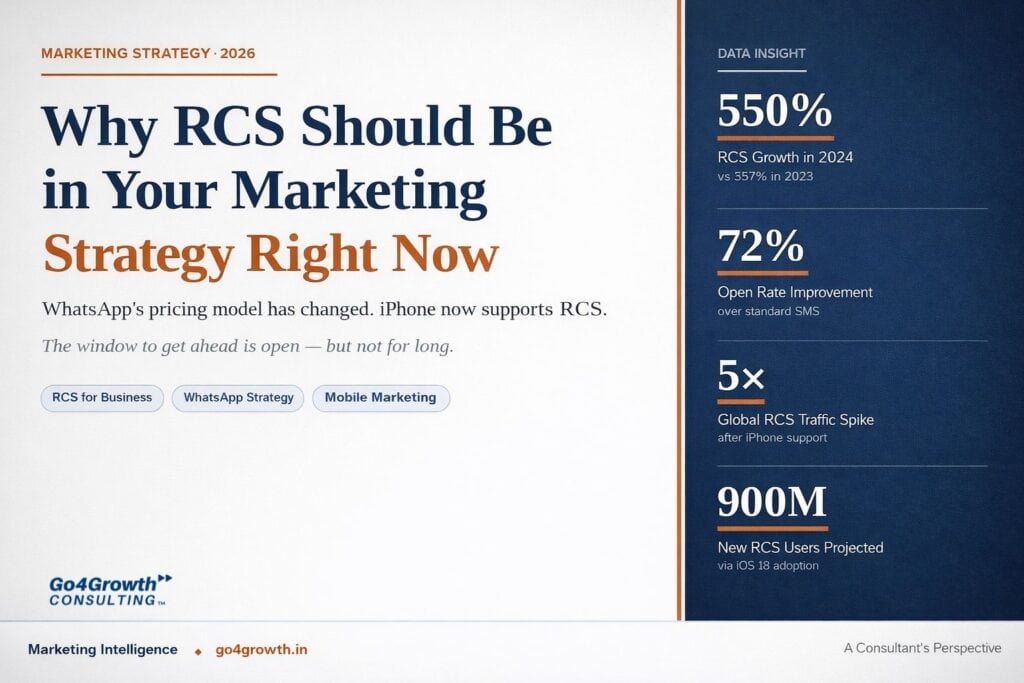
The numbers speak clearly here: global RCS traffic grew approximately 5x in 2024 after Apple joined the ecosystem. In North America alone, the surge was 14x. A billion daily RCS messages are now being exchanged in the United States. Juniper Research projected that Apple’s support would add 900 million new active users to the RCS channel.
For businesses, this isn’t just a technical update. It’s a distribution shift. The audience you can now reach through RCS for Business, on both Android and iPhone, has expanded dramatically.
What RCS Can Actually Do for Your Marketing
Let me be direct here: from a marketing strategy standpoint, RCS sits in a sweet spot that no existing channel currently occupies.
It has the reach of SMS — landing in the native inbox with no install friction. But it has the richness of a messaging app — carousels, images, buttons, replies. And it carries verified brand identity — your logo, your tagline, a checkmark showing the message is genuinely from you.
Verified Brand Identity
In a world drowning in phishing attempts and spoofed messages, a verified sender profile is a significant trust signal. Customers can see your brand name, logo, and a verification checkmark. The credibility that comes from this is hard to build through other channels.
Interactive Commerce Within the Message
One of the most compelling capabilities of RCS is something called WebView — the ability to embed web experiences directly within a message. Imagine a customer browsing a product carousel in their messaging inbox and completing a purchase without ever leaving the message thread. The drop-off that happens when you redirect people to a browser is eliminated. For e-commerce and high-consideration purchases, this is a significant conversion lever.
Better Data, Better Decisions
Unlike SMS, where delivery confirmation is unreliable and engagement is invisible, RCS provides real data: delivery receipts, read timestamps, and post-back data from button interactions. Marketers can now know not just whether a message was delivered, but whether it was read, which button was tapped, and at what time — all of which enables far more intelligent follow-up sequencing.
Open Rate Advantage
Industry data points to open rates improving by as much as 72% when comparing RCS to traditional SMS campaigns. The combination of visual richness, verified identity, and native inbox placement creates a compelling engagement dynamic.
| Strategist’s Perspective: RCS doesn’t replace your existing channels — it fills the gap between transactional SMS and conversational WhatsApp. Used correctly, it becomes a high-engagement broadcast-plus-interaction layer that your competitors likely haven’t built yet. |
What Is Happening with WhatsApp — And Why It Should Concern You
Many businesses, especially in India and other markets where WhatsApp penetration is high, have built their entire messaging strategy around WhatsApp Business. It’s understandable. The platform has extraordinary reach, near-universal adoption, and strong engagement. But the ground beneath it is shifting.
The Pricing Model Has Changed
From July 2025, Meta moved WhatsApp Business Platform pricing from a conversation-based model to a per-message model. What this means in simple terms: previously, you paid per 24-hour session and could send multiple messages within that window at no additional cost. Now, every template message — whether marketing, utility, or authentication — is billed individually.
Marketing messages, which are the most commonly used for outreach and promotions, are now individually charged at rates that vary by country. For high-volume campaigns, this adds up quickly. The days of blasting a large customer list with multiple follow-up messages inside a conversation window, all for a flat fee, are effectively over.
The Rules Are Getting Stricter
WhatsApp has also tightened the classification of message types. Utility templates — which attract lower charges — now face stricter scrutiny. You can no longer blend a transactional message with any promotional content without risking reclassification into the more expensive marketing category. WhatsApp is actively pushing businesses toward a quality-first, intent-based messaging approach.
Moreover, WhatsApp has imposed per-user marketing limits, meaning if a user is not engaging with your messages, you will be progressively restricted from reaching them. The mass-broadcast model of WhatsApp marketing is being dismantled — deliberately and systematically.
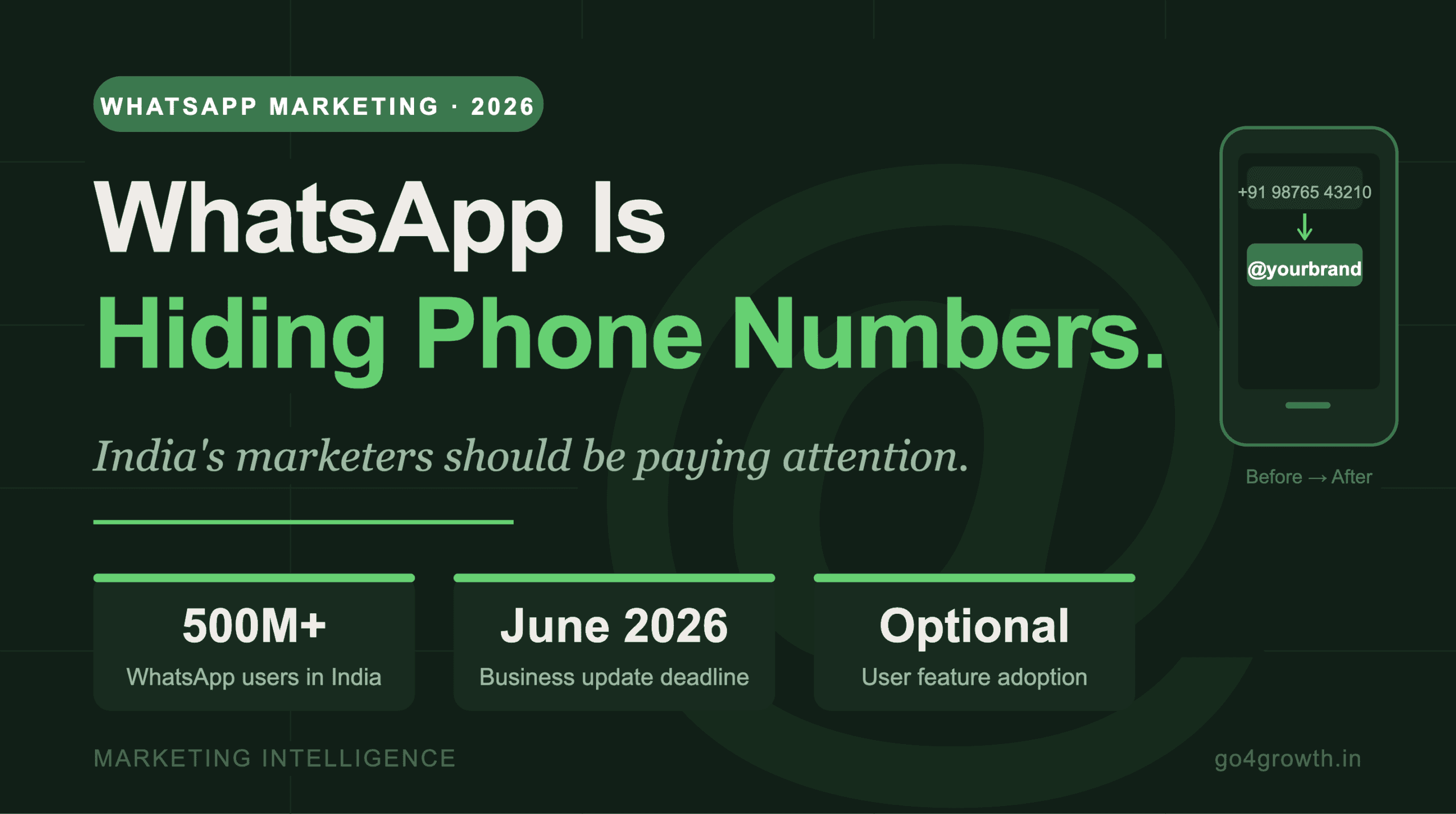
With WhatsApp hiding phone numbers and shifting to username-based identities, the entire foundation of WhatsApp marketing is about to change. Know more in the blog below.
The Cost Implication
For businesses doing serious volumes on WhatsApp, this translates to a meaningful cost increase unless messaging practices are tightened significantly. Combined with the operational effort of managing template approvals, categorizations, and compliance, WhatsApp marketing is becoming both more expensive and more demanding. That is a strong reason to look at what alternatives or complements exist.
| This is not a reason to abandon WhatsApp. It remains a powerful relationship channel, particularly for customer service and high-intent interactions. But it is a reason not to make WhatsApp your only mobile messaging strategy. |
RCS and WhatsApp — Not Versus, But Together
Here is where strategy gets interesting.
The instinct is often to frame this as a choice: WhatsApp or RCS? But that’s not the right frame. These channels serve overlapping yet distinct purposes, and a sophisticated marketing strategy will use both — intelligently.
Think of it this way:
- WhatsApp is a relationship channel. Its strength lies in two-way conversation, customer service, and high-intimacy communication. The opt-in nature, the personal feel of the interface, and the conversational dynamic make it ideal for nurturing relationships with customers who’ve already engaged with your brand.
- RCS is a broadcast-to-engagement channel. It’s closer in function to a sophisticated email or SMS campaign — but with the visual richness and interactivity of an app. It works well for acquisition touchpoints, product announcements, time-sensitive offers, and automated customer journeys.
A smart integration might look like this: You use RCS to run an interactive product campaign reaching your full mobile database. Users who respond or click through are identified as high-intent leads. You then move that segment into a WhatsApp conversation for personalised follow-up, closing the loop on a journey that began with broadcast and ended in dialogue.
This is omnichannel mobile marketing at its most effective — each channel doing what it does best, handing off to the other at the right moment.
What Businesses Should Do Right Now
If you’re serious about building a future-ready marketing infrastructure, here is how I’d frame the priorities:
1. Audit Your Current WhatsApp Dependency
Map out your current WhatsApp Business usage — volume, categories, costs, and engagement rates. Understand where the new per-message pricing hits you hardest and where you can restructure templates or journeys to reduce cost. This isn’t just damage control; it’s an opportunity to clean up messaging practices that were never as strategic as they should have been.
2. Explore Your RCS Readiness
Speak to your messaging platform providers — whether you use a cloud communications vendor or a marketing platform — and ask specifically about their RCS for Business capabilities. Assess carrier coverage in your primary markets. In India, for example, RCS adoption among telecom operators is growing and the addressable audience is substantial. Understand what it takes to get a verified sender profile set up.
3. Start With a Pilot
Don’t wait for RCS to become mainstream before you experiment. Brands that pilot today will have the learning curve behind them by the time mass adoption hits. Consider running a single campaign — a product launch, a seasonal offer, a reactivation series — purely on RCS. Measure engagement against your SMS or WhatsApp benchmarks. The data will tell you the story.
4. Build a Multi-Channel Mobile Strategy
The fundamental shift you need to make is moving from thinking about individual channels to thinking about mobile messaging as a portfolio. Email, SMS, RCS, WhatsApp, and push notifications each have a role. Orchestrating them based on customer behaviour, context, and intent is what separates brands that build lasting mobile relationships from those that just broadcast.
5. Invest in Message Quality, Not Message Volume
Both WhatsApp’s new pricing model and RCS’s engagement dynamics point in the same direction: message quality matters more than message quantity. A well-crafted RCS message with a compelling visual, a clear CTA, and personalisation will outperform ten generic text blasts. The shift in economics of WhatsApp is actually nudging businesses toward better marketing habits — take the hint.
The Bottom Line
RCS is not a future technology. It is a present-tense opportunity. With iPhone now fully in the picture, with carrier coverage expanding rapidly, and with major platforms like Twilio and Infobip making RCS capabilities widely accessible, the infrastructure is there. What’s missing for most businesses is the strategic intent.
WhatsApp will remain important — but its economics and rules are changing in ways that should prompt every business to diversify its mobile messaging mix. RCS is the most logical complement: open standard, no platform gatekeeping, verified branding, and richer engagement than anything SMS has ever offered.
For businesses serious about building marketing systems that work — not just campaigns that run — RCS deserves a seat at the strategy table. The question is not whether to include it. The question is how quickly you can move.
About the Author
Gagan Kapoor is a Marketing Consultant and the Founder of Go4Growth Consulting. He works with businesses across industries on marketing strategy, brand positioning, go-to-market planning, and building marketing systems that drive sustainable growth. He also leads corporate training programs for leadership and strategic thinking at large organisations.