
As businesses grow, an interesting thing happens to marketing.
There is usually more of everything. More campaigns, more agencies, more exhibitions, more content, more digital spending, more people and, increasingly, more technology. A growing business that once depended largely on relationships and market understanding may now have a marketing team, a CRM platform, multiple agency partners and a reasonably substantial annual marketing budget.
Yet, despite all this activity, many leadership teams continue to struggle with some surprisingly fundamental questions.
- Which customer segments should we prioritise?
- Why should customers choose us over increasingly similar competitors?
- Which markets represent the best opportunities for growth?
- Is our positioning genuinely differentiated?
- Are marketing and sales working towards the same customers and outcomes?
- Which marketing investments are actually contributing to business growth?
When these questions do not have clear answers, the problem may not be that the organisation needs more marketing.
It may need greater marketing capability.
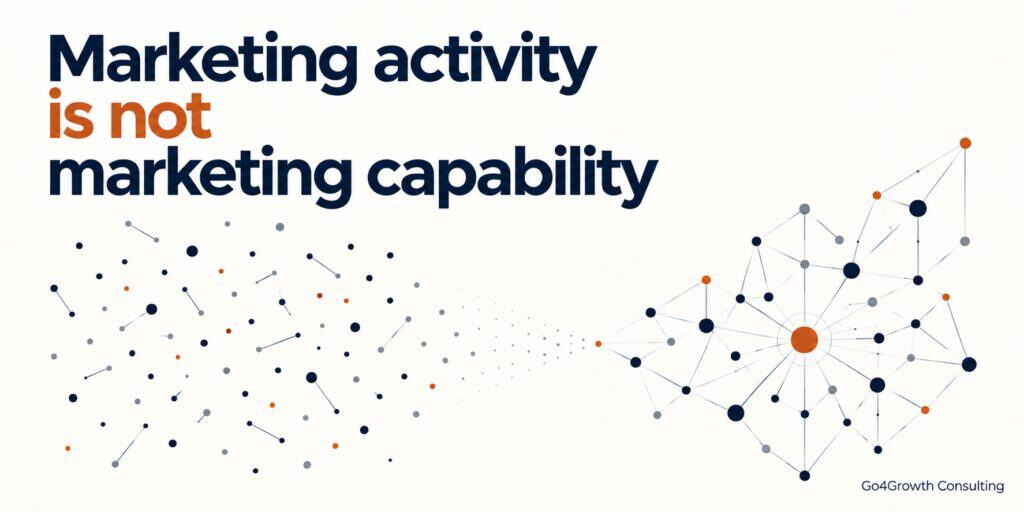
Marketing activity and marketing capability are not the same thing
Consider a hypothetical ₹200-crore manufacturing business.
It participates in six major exhibitions every year, works with a digital agency, regularly produces brochures and product catalogues, runs social media campaigns and has a five-member marketing team. From the outside, it would certainly appear to be marketing actively.
Now ask the leadership team to identify its three most valuable customer segments and explain why each should choose the company over its competitors. Ask how insights from lost sales opportunities influence its marketing decisions. Ask which exhibitions produce the most commercially valuable relationships, or how customer and competitor intelligence affects product, pricing and market-entry decisions.
The answers may suddenly become less certain.
The organisation doesn’t necessarily have a marketing activity problem. It has a marketing capability problem.
Now consider another business that perhaps spends less on marketing but operates very differently. It systematically studies customers and competitors, identifies priority segments, defines clear value propositions for them, captures market intelligence from its sales team, reviews why opportunities are won and lost, and regularly reallocates marketing resources based on what it learns.
The second organisation may actually be doing fewer marketing activities. But it possesses greater marketing capability.
That distinction becomes increasingly important as businesses scale.
So, what exactly is marketing capability?
In practical terms, marketing capability is an organisation’s ability to understand its market, make informed marketing choices and consistently translate those choices into customer and business outcomes.
The important word here is ability.
Having a CRM is a resource. Knowing how to use customer information from that CRM to improve segmentation, sales priorities and retention is a capability.
Hiring a marketing agency gives an organisation access to expertise. Knowing what the agency should accomplish, which customers it should target, what positioning it should communicate and how its performance should be evaluated requires capability within the organisation.
Similarly, attending exhibitions, running Google campaigns, creating content or implementing marketing automation can all be useful activities. But none of them, individually or collectively, establishes that an organisation has developed strong marketing capability.
This is why increasing marketing expenditure does not automatically produce better marketing.
What does marketing capability look like in a growing business?
Strong marketing capability does not reside only within a marketing department. It is reflected in a set of interconnected organisational abilities.
- It starts with market understanding. Does the organisation systematically understand customers, competitors, changing buying behaviour and emerging opportunities, or does most of this knowledge continue to reside in the minds of a few senior people?
- The next capability is segmentation and customer selection. Growing businesses frequently want to sell to everyone who could potentially buy from them. More mature marketing organisations make choices. They know which segments are strategically important, what those customers value and where the organisation should disproportionately invest its resources.
- Then comes positioning and value proposition. If competitors are making broadly similar claims about quality, service, experience and reliability, why should the customer choose you? A capable organisation can articulate differentiated value in terms that matter to the customer rather than simply describing its own products.
- The fourth is go-to-market capability. The question is no longer whether digital marketing, distributors, exhibitions, direct sales, partnerships, content or account-based marketing is ‘best’. The organisation understands which combination is appropriate for particular markets, customer segments and buying journeys.
- Equally important is sales and marketing integration. Marketing capability weakens considerably when marketing generates communication while sales operates independently. Customer conversations, objections, lost opportunities and competitor information from the field should continuously strengthen marketing decisions, while marketing should help sales prioritise markets, accounts and propositions.
- Finally, there is measurement and learning. Capable organisations do not simply measure what is easiest to count. They continuously ask what is working, what is changing, what they are learning about the market and where resources should move next.
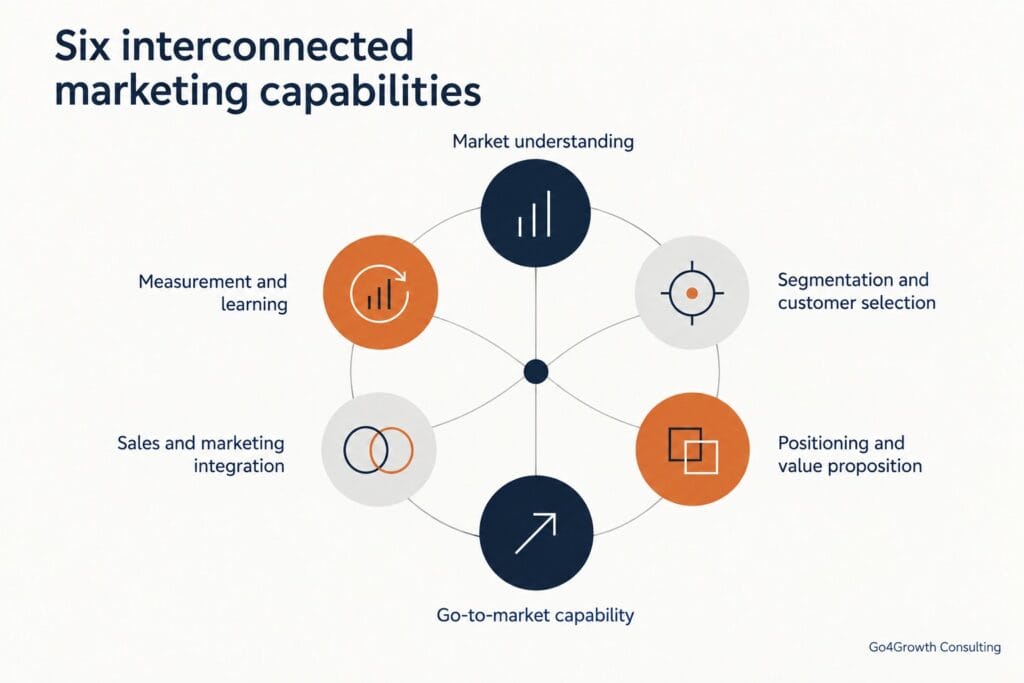
These capabilities reinforce one another. That is why marketing capability is much larger than the marketing department itself.
You cannot completely outsource marketing capability
This distinction has another important implication.
A business can—and often should—outsource specialist marketing activities. Advertising, digital marketing, content production, design, research, technology implementation and many other areas can benefit enormously from external expertise.
But the organisation cannot outsource its fundamental understanding of its customer and market.
An agency can help execute a campaign, but the organisation must ultimately know which customers matter. A research firm can provide market data, but management must know how that information changes strategic choices. A technology platform can provide sophisticated dashboards, but someone must know which questions are worth asking. External partners can strengthen marketing capability. They cannot substitute for its absence.
A useful test for leadership teams
Perhaps the simplest way to evaluate marketing capability is not to begin with the marketing budget at all. Instead, leadership teams should ask themselves five harder questions:
| 1. Can we clearly identify the customer segments that will drive our next phase of growth? |
| 2. Do our sales and marketing teams articulate our value proposition in broadly the same way? |
| 3. Does customer and competitor intelligence systematically reach the people making strategic decisions? |
| 4. Do we understand why we win and lose important business—and use those insights to make better marketing decisions? |
| 5. Can we connect our major marketing investments to meaningful commercial outcomes? |
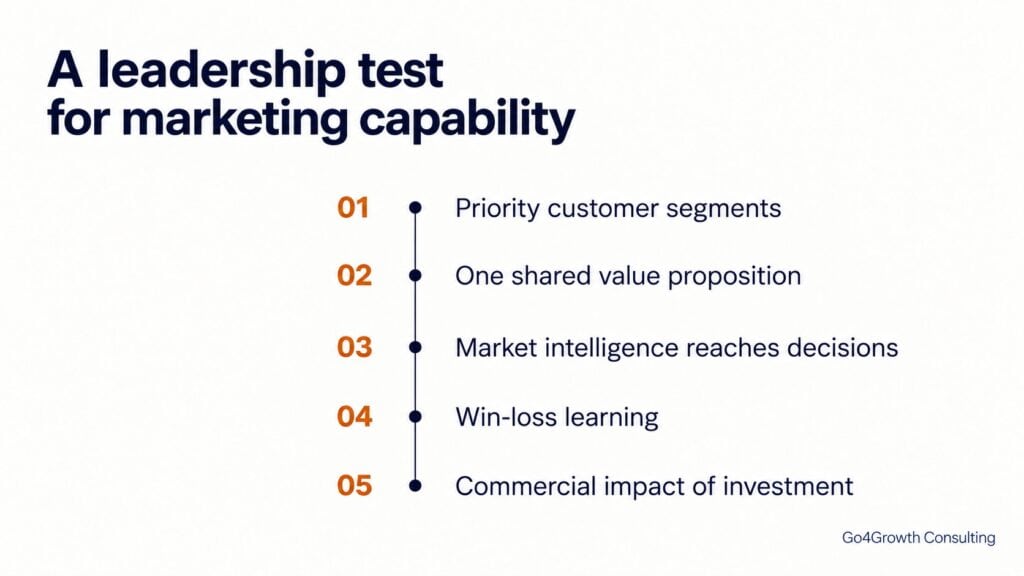
The answers to these questions reveal considerably more about an organisation’s marketing capability than the size of its marketing department, the number of campaigns it runs or the sophistication of its technology stack.
The next marketing investment may not be another marketing activity
For growing businesses, the temptation is understandable. When growth slows or competition intensifies, the instinctive response is often to increase activity: launch another campaign, appoint another agency, enter another channel, attend another exhibition or implement another technology platform.
Sometimes that is exactly what is required.
But before asking “What more should we do in marketing?”, leadership teams may benefit from asking a more fundamental question:
“What marketing capability do we need to build as an organisation?”
Because sustainable growth does not come simply from doing more marketing. It comes from becoming progressively better at understanding markets, making choices, executing those choices and learning from the results.
And as businesses become larger and markets become more competitive, that capability may ultimately matter far more than the number of marketing activities they undertake.
Author – Gagan Kapoor is a marketing strategy advisor and Principal Consultant at Go4Growth Consulting. He works with growing and mid-sized businesses to strengthen their marketing strategy, positioning and organisational marketing capability. His doctoral research explores marketing capability and how organisations can build it to support sustainable business growth.