B2B Marketing Strategy for Manufacturers: Turning Marketing Activities Into Demand
Gagan Kapoor
Principal Consultant
Ask a B2B manufacturer what the company does for marketing, and the answer may sound familiar: “We have a website. We participate in a few exhibitions. We have dealers in key markets. We have also invested in a CRM.”
These are useful investments. Yet a few questions can reveal a gap. Does the website help buyers understand where the company can add value? Are dealers equipped to develop demand? Do exhibition conversations continue after the event? Does the CRM help progress opportunities—or simply store contacts?
A business can have all these elements and still struggle to explain where its next customers will come from. Activities have their own budgets and owners, but little connection. Prospects repeat their requirements to different teams, promising enquiries lose momentum, and new-market entry still depends on someone opening a door.
The management question is whether these activities work together to help the business reach and win the customers it wants.
An effective B2B marketing strategy for manufacturers starts with the customers and applications the business wants to serve, and a credible reason for those buyers to choose it. The next task is to organise marketing around that direction. The Four-Part B2B Demand Framework makes that task practical.
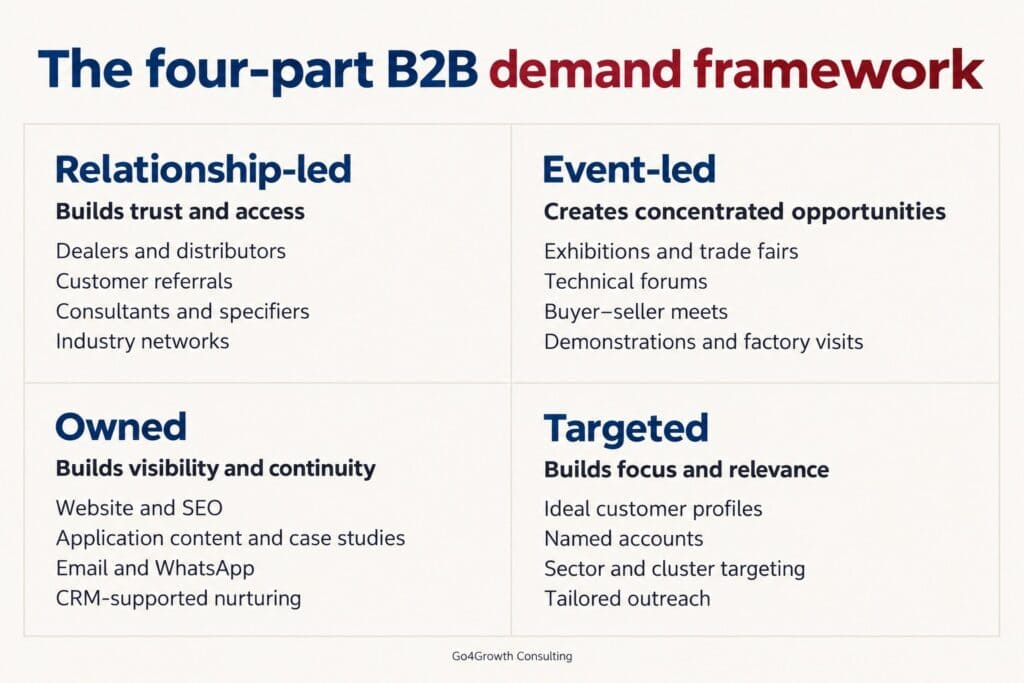
The Four-Part B2B Demand Framework
Each part has a distinct role in helping suitable buyers discover, evaluate and engage with your business. This includes developing future interest and responding to requirements that already exist.
These are connected capabilities. A case study can support a dealer, an event conversation and a target account. A CRM supports follow-through across all four. The framework helps assign a purpose to each activity and connect it to the buyer’s next decision.
1. Relationship-led demand builds trust and access
Relationships give buyers greater confidence in considering a supplier. Dealers provide local reach, customers introduce new opportunities, and professional influencers can shape selection without placing the order. The manufacturer needs to give this network useful reasons to recommend its products.
Core channels and activities
Dealers and distributors. Provide local access, customer relationships and support for product availability.
Existing customers and referrals. Open conversations with other plants, teams and businesses through demonstrated experience.
Consultants and specification influencers. Help shape the products and suppliers buyers consider.
Referral partners and professional networks. Create introductions through relevant associations, affiliates and industry relationships.
The manufacturer’s role
Equip the channel to create demand. Give dealers application guides, product comparisons and credible project evidence for customer conversations.
Support those who influence selection. Build relevant engagement with architects, consultants, contractors or technical specialists.
Develop customer introductions. Use successful projects to explore other sites, applications and suitable referrals.
Industry example — Building materials. A waterproofing manufacturer could support dealers with application guides and hold technical sessions for architects and contractors. These help explain suitable uses and installation requirements. The dealer supports local supply while the wider network builds confidence in selection.
Watch-out. Dependence on a few people or partners can restrict access to new markets.
Exhibitions, trade fairs and technical forums bring relevant buyers together. Demonstrations make capability tangible, while factory visits help prospects assess production capability and the people behind it. These formats create concentrated opportunities for discovery and evaluation.
Core channels and activities
Exhibitions and trade fairs. Bring suitable buyers into contact with products, demonstrations and technical teams.
Conferences and technical forums. Create focused discussions around industry needs and application challenges.
Buyer–seller meets. Enable introductions and requirement discussions with potential customers.
Demonstrations and factory visits. Help prospects assess performance, production capability and service support.
The manufacturer’s role
Choose events around market priorities. Select settings that attract buyers from the sectors and applications you want to develop.
Demonstrate relevant capability. Show how your equipment or expertise addresses a recognisable buyer problem.
Connect interest to a next step. Agree a technical discussion, evaluation or commercial conversation, with a named owner.
Industry example — Industrial machinery. A machinery manufacturer could demonstrate equipment at a trade fair, discuss a production bottleneck with plant managers at a technical forum, and invite a suitable prospect to its factory. Each interaction provides evidence that helps the buyer decide whether to proceed.
Watch-out. Event activity is intermittent; demand development must continue between exhibitions.
3. Owned demand builds visibility and continuity
Owned demand keeps your expertise accessible between meetings. Your website, content and direct communications help buyers evaluate the business and stay engaged as requirements develop. The company manages these assets, although search and messaging platforms still influence their reach.
Core channels and activities
Website, application pages and SEO. Help buyers discover the business and understand its relevance to their needs.
Technical content and case studies. Explain selection considerations and provide evidence of capability.
Email and relevant WhatsApp communication. Maintain useful, permission-based contact as buyer needs develop.
Databases and CRM-led nurturing. Organise prospect information and support timely, relevant follow-up.
The manufacturer’s role
Answer real application questions. Build website content around buyer needs, selection considerations and technical questions, supporting useful search discovery.
Substantiate your capability. Publish relevant specifications, documented case studies and evidence that helps buyers evaluate suitability.
Maintain relevant contact. Organise prospect information by application and buying stage, and connect useful follow-up to a clear response path.
Industry example — Specialty chemicals and polymers. A supplier could publish application notes, grade-selection guidance and documented trial results. A processor can assess relevant operating conditions before requesting an evaluation. Useful email updates maintain familiarity while the project develops.
Watch-out. Generic content and an unattended CRM create little value; relevance and follow-through matter.
4. Targeted demand creates focus and relevance
Targeted demand starts with choosing whom the business wants to serve. An ideal customer profile guides sector, geography and account selection. Account-based marketing and tailored outreach connect suitable organisations with relevant evidence through coordinated sales and marketing programmes.
Core channels and activities
Ideal customer profiles and account lists. Define suitable buyers and identify organisations worth developing.
Sector, geography and cluster targeting. Concentrate effort in markets where the business has a credible fit.
Account-based marketing and tailored outreach. Present relevant capability evidence to selected accounts and stakeholders.
Joint sales–marketing programmes. Coordinate messages, engagement and technical support around shared account priorities.
The manufacturer’s role
Select accounts against a clear profile. Prioritise organisations whose requirements fit your technical capability and commercial goals.
Map the buying group. Identify engineering, quality, procurement and operations stakeholders, and understand the evidence each needs.
Coordinate account development. Align sales, marketing and technical teams around account-specific conversations and evaluation milestones.
Industry example — Auto components. A components manufacturer could target OEMs and Tier-1 suppliers with suitable requirements. Engineering may need process and sample evidence, quality teams may examine systems, and procurement may assess supply capability. The account programme coordinates these needs rather than sending everyone the same introduction.
Watch-out. A target list achieves little without a credible fit, relevant engagement and a meaningful next step.
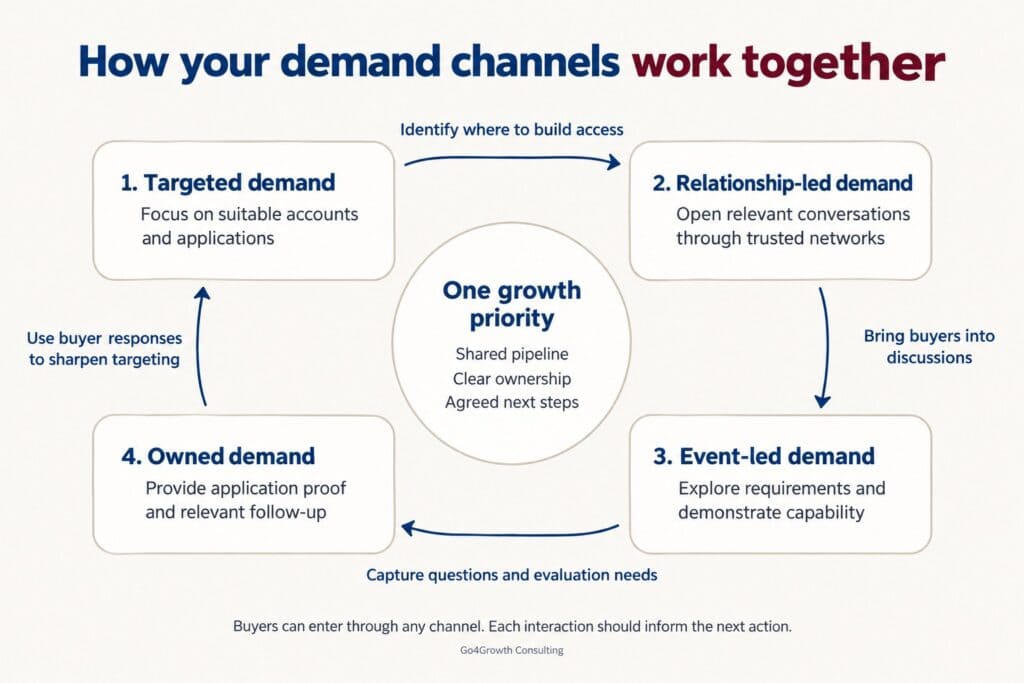
Connect the four channels around one growth priority
Consider a packaging manufacturer pursuing regional food companies. Its marketing effort becomes more purposeful when all four channels support that same customer priority. The connections can work in several directions; buyers do not need to follow a fixed sequence.
Use relationships to open relevant doors. Ask suitable distributors and existing customers for introductions to food companies whose requirements fit your capabilities.
Use targeted outreach to develop those accounts. Identify packaging-development and procurement stakeholders, understand their application and invite them to a relevant technical discussion.
Use events to make capability tangible. Bring suitable prospects to a demonstration or arrange meetings at a relevant exhibition, supported by the technical team.
Use owned content to support evaluation. Share an application page or credible case study that helps the buyer assess suitability and discuss it internally. Use recurring buyer questions to improve that content.
Manage one shared opportunity pipeline. Give each opportunity an owner and an agreed next step. Record the original source and later contributions without counting the same opportunity several times.
Build a manageable demand mix
Shortlist one or two relevant activities from each channel around your chosen growth priority. Retain what works, identify the missing support and sequence improvements according to your team’s capacity. The mix needs to cover all four roles; spending and effort need not be equal.
For example, a machinery business may put more effort into demonstrations and named accounts, while a building-materials company may prioritise partners and specification support. Strengthen the gap most likely to obstruct your growth objective, while connecting that improvement to the other channels.
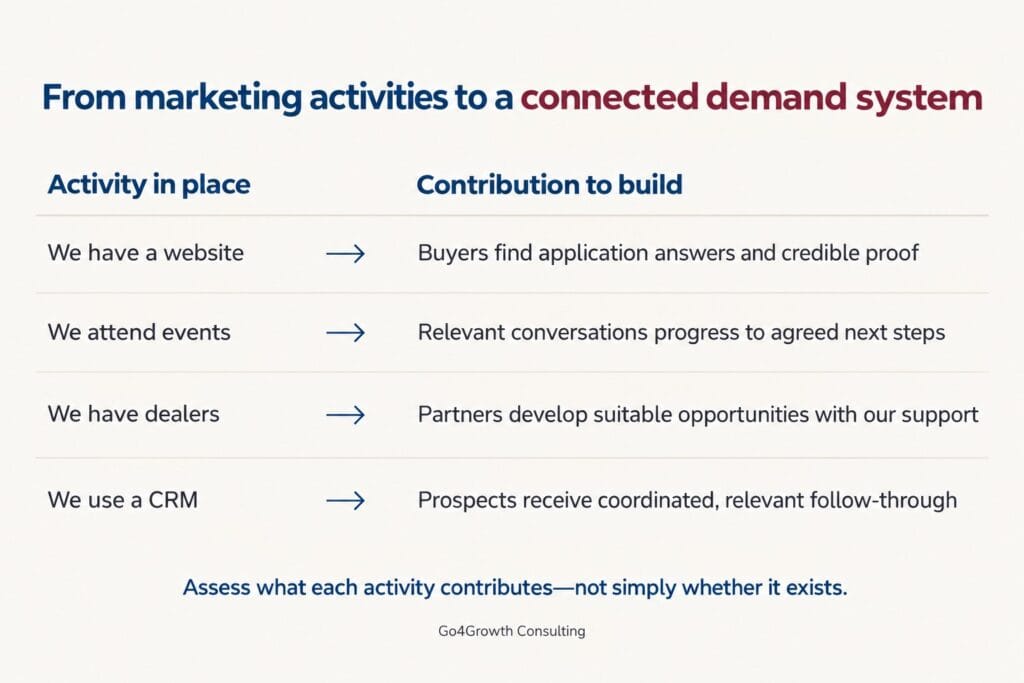
Checklist for a connected demand system
Review these questions with sales, marketing and technical colleagues. Mark each row as working, partly working or a gap, using a recent opportunity as evidence. Owning a tool is not enough to mark its role as working.
Use the review to agree which gap matters most for your next growth priority, what will change, who owns the improvement and when you will assess progress. Judge that progress through relevant conversations, technical evaluations and qualified opportunities, alongside eventual orders.
The next step is to make your marketing investments work together. Give each activity a clear role, connect it to the customers you want to serve, and make someone accountable for moving the opportunity forward.
Author – Gagan Kapoor is a marketing strategy advisor and Principal Consultant at Go4Growth Consulting. He works with growing and mid-sized businesses to strengthen their marketing strategy, positioning and organisational marketing capability. His doctoral research explores marketing capability and how organisations can build it to support sustainable business growth.
Gagan Kapoor
Principal Consultant, GO4GROWTH
26 years of marketing and consulting experience. Has advised 460+ organisations and trained 69,000+ professionals across India. Writes on marketing strategy, brand positioning, and business growth.
GO4GROWTH IN NUMBERS
Trusted by hundreds of businesses across India.
0+
ORGANISATIONS
CONSULTED
0+
INDUSTRIES
SERVED
0k+
PROFESSIONALS
TRAINED
0+
YEARS
EXPERIENCE
CHALLENGES WE SOLVE
Does Your Marketing
Actually Work?
Take the Go4Growth Marketing Health Check — get a personalised score across 7 dimensions, an AI-powered strategic insight, and your top 3 priority actions..